
A pop culture blog by a college English professor focusing on comic books and movies. Featuring frequent reviews of graphic novels, comic books, books, and movies.
Updated: 32 min 19 sec ago
The Bureau Chiefs!

As I've mentioned before here, I'm part of the team collectively known as "The Bureau Chiefs" who put out humorous tidbits at Fake AP Stylebook on Twitter. This week, the Bureau Chiefs website went live at www.thebureauchiefs.com.
The site will feature our humorous take on the news and pop culture, as well as feature articles and reviews. My first piece, a review of Joe Hill's new novel, Horns, went up today.
 In addition to occasional book reviews, I'll also have a regular feature where I write about a different cult movie every Friday. This will be in a format and approach similar to what I use when writing about horror and sci-fi movies during the Halloween Countdown every year, so if you like that, you definitely should check this out.
Also, the launch of the Bureau Chiefs site means some changes for things here at the 100-Page Super Spectacular. For the past few months, I've basically been limiting myself here to the weekly Gil Kane punches and Blackhawk posts (the latter of which which has been unfortunately absent the last two weeks). While I have written about movies and prose fiction on this blog in the past, I'm pretty much moving all that writing over to the Bureau Chiefs site. That will leave this blog for writing about comics, which is ostensibly what it has been for a while, anyway. Once I get ahead on some of the assignments for the Bureau Chiefs, I hope to expand the comics writing here beyond the two regular features that I've been limited to for some time (and I promise to get back on track with the Blackhawk posts).
I'll also post an announcement here when new stuff of mine goes up on the other site. Since that site isn't set up for comments, feel free to drop in any comments here about my stuff.

Categories: Blogs of The Bureau Chiefs
The Gil Kane Punch of the Week 35: The Finishing Touch!
I know I've been dipping into the Green Lantern well quite a bit over the last few weeks, but I've been fascinated with the evolution of Kane's style that can be traced through the four Showcase Presents Green Lantern volumes. Volume 1 is virtually punchless, and throughout those stories, Green Lantern tends to use his ring as more of a defensive weapon, or his ring constructs are used more to detain bad guys than to knock them out. This pattern holds true through most of volume 2, though we begin to see more punching occuring around issue 28, when writers Gardner Fox and John Broome start creating plots where GL's ring is useless in defeating the villain. With volume 3, the punches start coming hard and fast, and the typical Gil Kane punch becomes a regular part of Kane's repertoire, often appearing multiple times in a single story.
That brings us to Green Lantern 56 (Oct. 1967), written by Gardner Fox and pencilled and inked by Kane, which is the second part of a punchtastic two-parter that brings together the entire Green Lantern Corps. To mix things up a bit, I've chosen a punch not from Hal Jordan, but instead from one of Hal's mentors, Tomar-Re. Here, a winged Tomar-Re knocks out fellow Zudarian, Zoraldo.
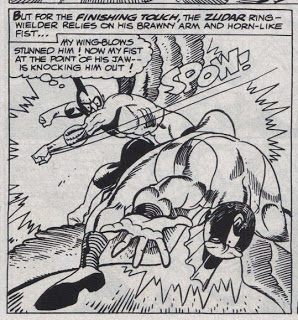
"Now my fist at the point of his jaw--is knocking him out!" Yes, Tomar--on Earth, we refer to that as "a punch." I do like it, though, that Tomar, who is not used to fisticuffs, still leads with his left.
That brings us to Green Lantern 56 (Oct. 1967), written by Gardner Fox and pencilled and inked by Kane, which is the second part of a punchtastic two-parter that brings together the entire Green Lantern Corps. To mix things up a bit, I've chosen a punch not from Hal Jordan, but instead from one of Hal's mentors, Tomar-Re. Here, a winged Tomar-Re knocks out fellow Zudarian, Zoraldo.

"Now my fist at the point of his jaw--is knocking him out!" Yes, Tomar--on Earth, we refer to that as "a punch." I do like it, though, that Tomar, who is not used to fisticuffs, still leads with his left.
Categories: Blogs of The Bureau Chiefs
The Gil Kane Punch of the Week 34: The Punch Came C.O.D.!
From Green Lantern 37 (June 1965), in a story called "The Spies Who 'Owned' Green Lantern!" comes a rather unconventional punch:
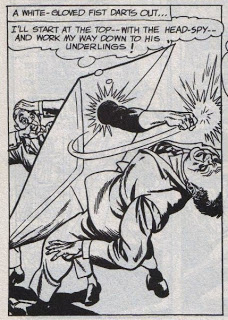
In this story, written by Gardner Fox and inked by Sid Greene, Hal Jordan finds himself under the hypnotic spell of a spy ring, so in order to break that spell, GL commands his ring to shrink him down in his sleep, and then he has Pieface mail him to the spies. This plan doesn't really make any sense, but it does give GL this opportunity to punch his way out of an envelope.

In this story, written by Gardner Fox and inked by Sid Greene, Hal Jordan finds himself under the hypnotic spell of a spy ring, so in order to break that spell, GL commands his ring to shrink him down in his sleep, and then he has Pieface mail him to the spies. This plan doesn't really make any sense, but it does give GL this opportunity to punch his way out of an envelope.
Categories: Blogs of The Bureau Chiefs
Blackhawk Wingsdays: The Outcasts of Blackhawk Island!

The Blackhawks have fought and defeated (often by accident) many enemies that threaten the peace of the world. However, Blackhawk 202 (Nov. 1964) reveals one enemy that they simply cannot defeat: age descrimination!

Also in this issue: the Blackhawks actually fly their goddam planes!
I do want to point out, though, that the splash page here is a pants-on-fire liar. As a Blackhawk scholar, I must address this claim that Blackhawk Island has "never been seen by outsiders." In fact, a quick perusal of the Showcase Presents: Blackhawk volume proves that the black knights were letting reporters and others on the island all the time. So, I'm calling bullshit on this.
In this issue, the Blackhawks battle the Hammer, yet another criminal mastermind who uses elaborate machines to commit his crimes, like this giant flying saucer that vacuums up precious minerals.
Though the Blackhawks handily defeat the Hammer's flying saucer, little do they know that the villain has an ulterior motive: he wants to track the team's flight path in order to trace the location of Blackhawk Island.

This is a pretty elaborate plan when he could have just googled "Blackhawk Island location" and gotten the same result.
On the island, the team undergoes some rigorous training, which often results in Hendrickson receiving some ribbing for his age. To prove he's not an old man, Hendy performs a triple gainer and knocks Stan into the water:


Meanwhile, in a sub off the coast of Blackhawk Island, Hammer launches Operation Methusaleh, which involves some kind of green gas that causes all who come in contact with it to age rapidly.

Right here is where Hammer's plan falls apart, even before it gets started. There is a wide variety of poison gases that Hammer could have used here that would wipe out the Blackhawks instantly and give him total access to this secret, uncharted island. Instead, he has to get all fancy with this bullshit aging gas.
The Blackhawks' system of fans keeps the gas--which they think is just a weird green fog--just off shore. Soon, though, a report comes in of pirate activity, and Blackhawk sends Andre, Hendrickson, and Stan out in the Blackhawk sub in order to investigate. In the process, the trio get exposed to the green gas. Of course, if they had just flown in their planes--which is what the Blackhawks do, after all--this wouldn't be a problem.
The three heroes don't actually find any pirate activity, and so they head back to the island. Soon, though, the exposure to the gas takes effect:

Man, I just love how Andre talks to himself in the mirror. Unfortunately, his pussy-hounding days are over as he turns into a decrepit old man.
The same happens to Hendrickson and Stan as well:

Also, in an odd turn of events, Blackhawk's own right arm becomes withered and old, possibly because Andre touched him there.

You don't want to know what else became withered and old because Andre touched it.
With this turn of events, Blackhawk has no choice but to make a drastic decision that opens him up to a huge age-descrimination lawsuit: the three old men must be fired because the team can't waste resources dragging along some senior citizens.

No retirement party, no gold watch--the three seniors are just put in a boat and cast adrift.
This proves to be a huge mistake, as Hammer makes his way onto the island with his various gadgets and has his way with the remaining Blackhawks:

With all the young Blackhawks captured, the three old men return to the island to live out their final days, and since Hammer does not see them as a threat, he lets them do what they want.

However, even as old men, the Blackhawks shouldn't be counted out. All of the senior citizen paraphernalia turns out to be cleverly hidden weapons. Andre's cane is actually a rifle, and Stan's ear trumpet...

Also, Hendrickson has somehow hidden a giant bazooka in his wheelchair:

Once Hammer is captured, the Blackhawks have a couple of dilemmas to solve: one, they need to find out how to de-age their teammates, and two, they need to do something about the fact that Hammer and his henchmen know the location of Blackhawk Island.
Luckily, they have a Nazi machine that will take care of both problems:

The story ends without Blackhawk acknowledging that he was wrong to exile Andre, Stan, and Hendrickson just because they are old. In fact, he could have gotten off by just saying, "It was my plan all along to have the three old men return and save us!" And so, the discriminatory labor policies of Blackhawk Island remain intact and unchallenged.
According to the Grand Comics Database, "The Outcasts of Blackhawk Island" was written by Bob Haney, even though he's not credited in the issue itself. Though this story certainly has touches of that patented Bob Haney insanity, I had always thought Haney didn't come on this book until issue 203. I'll have to double-check my records on this.

Categories: Blogs of The Bureau Chiefs
The Gil Kane Punch of the Week 33: Right Makes Might!
A few weeks back, I mentioned that Green Lantern 58 (Jan. 1968), was a pretty punchtastic issue. In "Peril of the Powerless Green Lantern!" written by Gardner Fox and inked by Sid Greene, GL finds he is having strange reactions to his adventures, such as overwhelming fear, greed, and sadistic tendencies toward criminals. For example, he really lays into three common thugs:
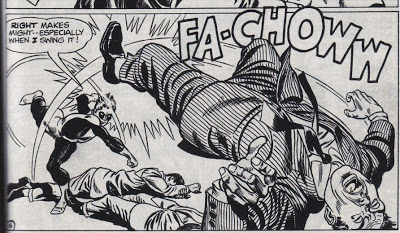
The Guardians diagnose him with combat fatigue and strip him of his ring, but he still has to face some challenges, as detailed in this earlier post.
Also in this issue, a powerless Hal Jordan spends two pages beating the shit out of a bear:
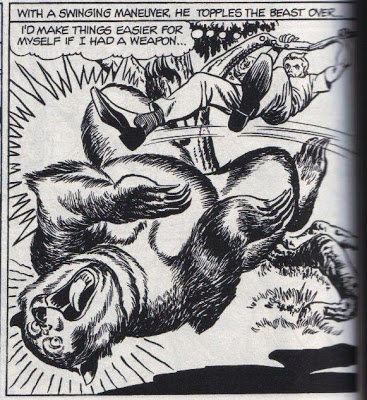
I can tell you right now, that bear does not appreciate the taste of Florsheim.

The Guardians diagnose him with combat fatigue and strip him of his ring, but he still has to face some challenges, as detailed in this earlier post.
Also in this issue, a powerless Hal Jordan spends two pages beating the shit out of a bear:

I can tell you right now, that bear does not appreciate the taste of Florsheim.
Categories: Blogs of The Bureau Chiefs
Blackhawk Wingsday: The Enemy Blackhawk Creatures!
During this period of change in the Blackhawk series, a recurring plot occurs in which one or more of the Blackhawks turns against the rest of the team, usually by being transformed into a monster by an evil scientist. Once again, one really has to question the efficacy of a crime fighting team that spends most of their time either fighting each other or rescuing their leader from deadly peril of their own making.
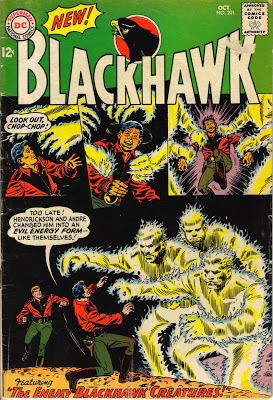
"The Enemy Blackhawk Creatures," from Blackhawk 201, fits this pattern, as the cover shows team members getting transformed into bizarre energy creatures. However, the splash page seems to set up an entirely different story:
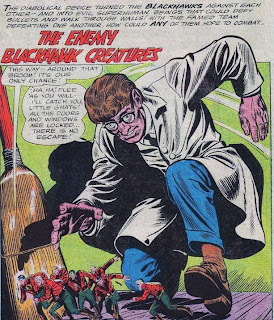
It seems like the writer (and no writer is credited here, but it may have been Arnold Drake, who did much of the writing of the series along with France Herron, until Bob Haney took over a few issues later) couldn't decide if he wanted to do tiny Blackhawks or electrical Blackhawks, and instead put both hands together and combined the two.
The story opens with the Blackhawks chasing after some daring crooks who have just stolen the famed "Pearl of India" from the local museum. Andre manages to tackle one of the thugs before he escapes on a helicopter, but in the ensuing melee, the pearl comes loose:
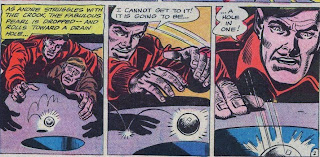
So, while the crime was foiled, Andre feels bad that he managed to lose the pearl down a drain hole, and he makes a strange wish: he wants to be small so that he could fit down the drain and recover the pearl.
Coincidentally, Andre's request is overheard by Cheech and Chong, who help Andre get small. Actually, it's the famous Professor Milbrook, who has recently been in the news for his unorthodox scientific experiments. He informs Andre that a new device he has invented will help him achieve his desire for shrinking.
Milbank takes Andre to his lab, where he demonstrates the machine on a rabbit. After the first blast of the machine, the bunny becomes a giant electrical rabbit, then another blast turns it into a palm-sized hare. Deciding that absolutely nothing could go wrong with this, Andre volunteers to be the machine's next subject.
It turns out, however, that Professor Milbrook has other plans, and he only exposes Andre to the first blast:
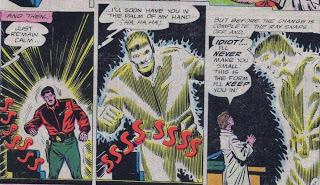
As a mindless creature of pure energy, Andre becomes the professor's slave, and the evil scientist turns the monster on the Blackhawks.
During the ensuing battle, Hendrickson and Chop-Chop are also turned into electrical creatures, and while Blackhawk discovers that the creatures are weakened by water, he and the remaining team members are unable to stop them. That means Blackhawk has to come up with another plan: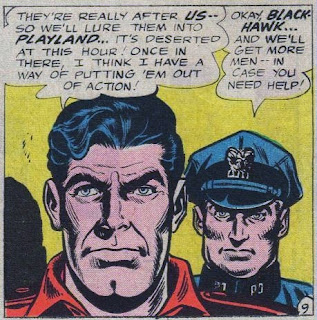
The plan to lure the creatures to "Playland" amusement park turns out to be total crap, as Blackhawk has no idea what to do with the creatures once he's lured them in there. Instead, all the Blackhawks are captured and turned into energy creatures.
Milbrook then reveals a side-effect of his device: the energy creatures will automatically turn small after a certain period of time elapses, so in order to control his new captives, he just makes them small at the same time:
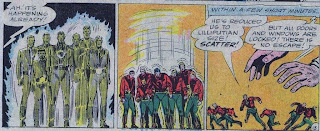
While tiny, the Blackhawks manage to pick up a broom and cold-cock the professor with it, knocking him out cold. They then sneakily turn the device on him. Little Milbrook and Tiny Blackhawk fight, and Milbrook's face is dislodged, revealing that he isn't Milbrook after all:
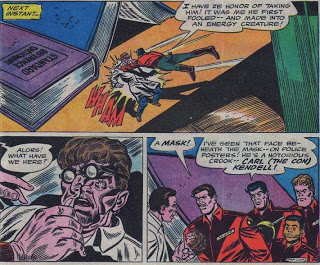
Karl (The Con) Kendell--the criminal with the worst nickname--kidnapped the real Professor Milbrook and used his devices to further his criminal career. In fact, he had set the whole thing up with the pearl thieves in the first place.
So, let me make sure this is straight: Kendell's plan all along was to turn the Blackhawks into his own personal army of energy creatures. In order to achieve this goal, he hires a gang to rob the museum of the Pearl of India, confident that the Blackhawks will answer the museum alarm. Then, knowing full well that the Blackhawks will botch the collar, Kendell has the crook intentionally drop the pearl down a drain. Kendell does this so that the Blackhawks will wish they could shrink and, therefore, will be amenable to his offer to use the shrinking machine invention. That is one goddam fool-proof plan.
As part of Kendell's punishment, he is dropped by string down the drain in order to recover the pearl.
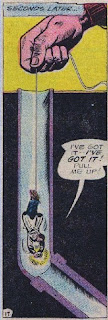
At the end of the story, the Blackhawks seem to want to play with Kendell like a little toy doll for a while before they return him to normal size.

"The Enemy Blackhawk Creatures," from Blackhawk 201, fits this pattern, as the cover shows team members getting transformed into bizarre energy creatures. However, the splash page seems to set up an entirely different story:

It seems like the writer (and no writer is credited here, but it may have been Arnold Drake, who did much of the writing of the series along with France Herron, until Bob Haney took over a few issues later) couldn't decide if he wanted to do tiny Blackhawks or electrical Blackhawks, and instead put both hands together and combined the two.
The story opens with the Blackhawks chasing after some daring crooks who have just stolen the famed "Pearl of India" from the local museum. Andre manages to tackle one of the thugs before he escapes on a helicopter, but in the ensuing melee, the pearl comes loose:

So, while the crime was foiled, Andre feels bad that he managed to lose the pearl down a drain hole, and he makes a strange wish: he wants to be small so that he could fit down the drain and recover the pearl.
Coincidentally, Andre's request is overheard by Cheech and Chong, who help Andre get small. Actually, it's the famous Professor Milbrook, who has recently been in the news for his unorthodox scientific experiments. He informs Andre that a new device he has invented will help him achieve his desire for shrinking.
Milbank takes Andre to his lab, where he demonstrates the machine on a rabbit. After the first blast of the machine, the bunny becomes a giant electrical rabbit, then another blast turns it into a palm-sized hare. Deciding that absolutely nothing could go wrong with this, Andre volunteers to be the machine's next subject.
It turns out, however, that Professor Milbrook has other plans, and he only exposes Andre to the first blast:

As a mindless creature of pure energy, Andre becomes the professor's slave, and the evil scientist turns the monster on the Blackhawks.
During the ensuing battle, Hendrickson and Chop-Chop are also turned into electrical creatures, and while Blackhawk discovers that the creatures are weakened by water, he and the remaining team members are unable to stop them. That means Blackhawk has to come up with another plan:

The plan to lure the creatures to "Playland" amusement park turns out to be total crap, as Blackhawk has no idea what to do with the creatures once he's lured them in there. Instead, all the Blackhawks are captured and turned into energy creatures.
Milbrook then reveals a side-effect of his device: the energy creatures will automatically turn small after a certain period of time elapses, so in order to control his new captives, he just makes them small at the same time:

While tiny, the Blackhawks manage to pick up a broom and cold-cock the professor with it, knocking him out cold. They then sneakily turn the device on him. Little Milbrook and Tiny Blackhawk fight, and Milbrook's face is dislodged, revealing that he isn't Milbrook after all:

Karl (The Con) Kendell--the criminal with the worst nickname--kidnapped the real Professor Milbrook and used his devices to further his criminal career. In fact, he had set the whole thing up with the pearl thieves in the first place.
So, let me make sure this is straight: Kendell's plan all along was to turn the Blackhawks into his own personal army of energy creatures. In order to achieve this goal, he hires a gang to rob the museum of the Pearl of India, confident that the Blackhawks will answer the museum alarm. Then, knowing full well that the Blackhawks will botch the collar, Kendell has the crook intentionally drop the pearl down a drain. Kendell does this so that the Blackhawks will wish they could shrink and, therefore, will be amenable to his offer to use the shrinking machine invention. That is one goddam fool-proof plan.
As part of Kendell's punishment, he is dropped by string down the drain in order to recover the pearl.

At the end of the story, the Blackhawks seem to want to play with Kendell like a little toy doll for a while before they return him to normal size.
Categories: Blogs of The Bureau Chiefs
The Gil Kane Punch of the Week 32: SKROGG!
Sometimes, I just like to open one of the Showcase Presents: Green Lantern volumes randomly and see if I can land on a page with a Gil Kane punch. The first volume is relatively punchless, perhaps indicating that the historical development of the Gil Kane punch evolved over the course of his Silver Age superhero work. By the time we get to the issues collected in volume 3, however, the punch has clearly become Kane's signature move, and we can find as many as five or six punches per issue.
Case in point: this image from Green Lantern 54, "Menace in the Iron Lung," written by John Broome, with a rare instance of Kane inking his own pencils at this time.
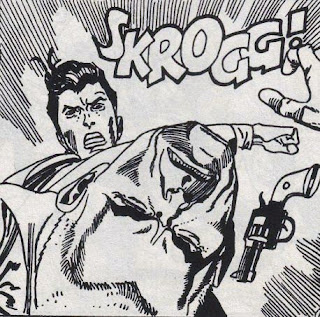
This is, by all means, a pretty standard Gil Kane punch, with Hal Jordan slugging the guard of the titular villain's estate (it does, however, get bonus points for the sound effect, "SKROGG!"). But a quick scan through the issue reveals no fewer than seven typical Gil Kane punches, plus several variations. The plethora of punches in this issue, in fact, makes me realize that a taxonomy of Gil Kane punches is long overdue, and I really need to get to work on that.
Case in point: this image from Green Lantern 54, "Menace in the Iron Lung," written by John Broome, with a rare instance of Kane inking his own pencils at this time.

This is, by all means, a pretty standard Gil Kane punch, with Hal Jordan slugging the guard of the titular villain's estate (it does, however, get bonus points for the sound effect, "SKROGG!"). But a quick scan through the issue reveals no fewer than seven typical Gil Kane punches, plus several variations. The plethora of punches in this issue, in fact, makes me realize that a taxonomy of Gil Kane punches is long overdue, and I really need to get to work on that.
Categories: Blogs of The Bureau Chiefs
The Gil Kane Punch of the Week 31: Taste Fisted Flesh!
As I mentioned the other day, I've really dropped the ball the last couple of weeks on the Gil Kane punches, so I'm going to try to do some catch-up here with this glorious page from Warlock 3 (Dec. 1972), written by Mike Friedrich and inked by Tom Sutton.
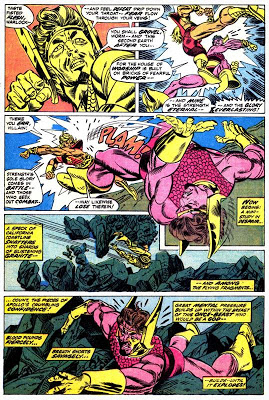
Friedrich's dialogue on this whole page is just fantastic--it seems written specifically to match the dynamic action of Gil Kane's style. I know the next time I punch somebody, I'm going to open with "Taste fisted flesh and feel defeat drip down your throat!"
I'd like to thank pal Bully at Comics Oughtta Be Fun for sending me the scan of that great page. And I'd like to take this opportunity to invite any readers who might have favorite Gil Kane punches to send in scans--any contributions will be greatly appreciated!
Categories: Blogs of The Bureau Chiefs
Blackhawk Wingsdays: The Fabulous Blackhawk Freaks!
Back in October, during the Halloween Countdown, I covered the lead story in Blackhawk 199, where the Blackhawks fight a band of mutated alien mummy insects. Between Blackhawk 196 and 199, the team did away with their classic "black-but-looks-blue" leather uniforms for something more colorful and modern. This was, of course, a huge mistake--one of many that will plague this series until its cancellation several years later. (It was in issue 197, to be exact--an issue that is, unfortunately, not in my collection. Neither is 198, which features a new origin for the Blackhawks. I need to get my hands on those comics!)
The second story in issue 199 anticipates one of the more dramatic changes to come in the series, as three of the Blackhawks are turned into super-powered freaks in "The Fabulous Blackhawk Freaks!" (Which, unfortunately, does not involve the Blackhawks teaming up with Gilbert Shelton's Fabulous Furry Freak Brothers, though that would have been awesome.)
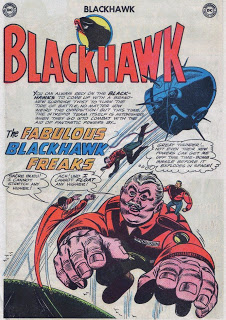
As the story opens, the Blackhawks stumble across some bizarre landscaping being done in some random, unnamed forest: an antigravity beam is tearing up trees. Blackhawk splits the team up into two groups: Andre, Hendrickson, and Chop-Chop head off in one direction, and Blackhawk, Stanislaus, Chuck, and Olaf go in the other. Blackhawk's team is quickly confronted by one of the innumerable alien races that artist Dick Dillin created during his long career:
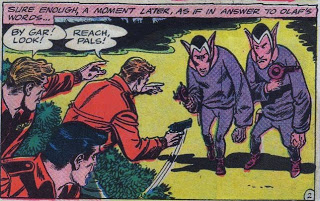
That team is then captured in a giant bubble that inspires Chuck to blurt out one of his many catch-phrases:
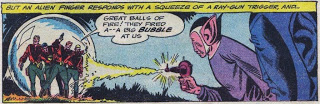
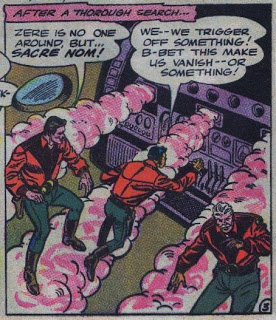
They break the bubble by rolling it down a hill. Meanwhile, the other team has found the aliens' ship, and, in typical Blackhawk fashion, they monkey with shit until it gets them in trouble:
The two teams reunite in order to compare notes, and we get to see that the alien gas wasn't as harmless as they thought. First, Hendrickson inflates into a giant flying Dutchman:
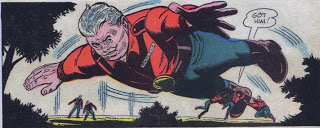
(Note: I didn't make up that corny pun--it's actually in the story.)
Andre anticipates Bootsy Collins:
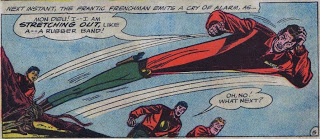
And Chop-Chop anticipates Major League Baseball over the past 15 years or so:
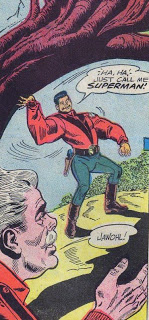
Everyone quickly returns to normal after demonstrating their new powers, and Blackhawk decides to delay worrying about that in favor of dealing with the immediate problem: the new alien threat. To this end, Blackhawk splits the team up yet again, since that worked so well last time. Now, though, he goes off alone to find the aliens, while everyone else goes off to destroy the alien ship.
When Blackhawk finds the aliens, however, he discovers that they are not the threat his xenophobic prejudices caused him to think they were. They are, in fact, here on Earth to dispose of a dangerous bomb that crashed on the planet. They were planning on hauling it away into space before it detonated.
Blackhawk tries to warn the other team, but his cheap-ass radio is busted, and, in a rare instance of efficacy, the other members of the team have actually accomplished their mission, using Chop-Chop's new strength to wreck the ship.
Now they need a new plan to get the bomb off the planet. Blackhawk hastily puts together a half-assed strategy to carry the bomb on Hendrickson's inflatable back and then have Chop-Chop launch the bomb into space once Hendy achieves his maximum height.
And, of course, they fuck this up:
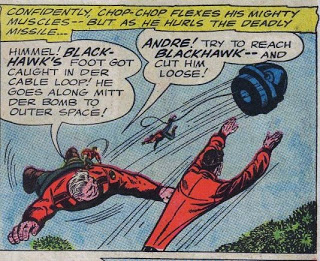
Andre tries to stretch out and reach his leader, but Blackhawk's velocity is too fast, and he's soon out of reach. And, again as usual, he has to save himself while his useless team members sit and watch.
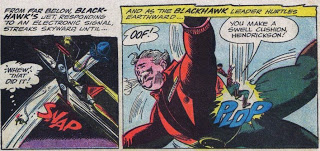
At least Hendrickson proves useful.
The bomb then goes off harmlessly in the stratosphere, while back on Earth, the new powers have worn off, and the Blackhawks now have to fix the aliens' spaceship manually.
By the way, I know I've dropped the ball lately on the Gil Kane punches, but I plan to get a couple up in the next few days in order to get back on schedule. My apologies for that.
The second story in issue 199 anticipates one of the more dramatic changes to come in the series, as three of the Blackhawks are turned into super-powered freaks in "The Fabulous Blackhawk Freaks!" (Which, unfortunately, does not involve the Blackhawks teaming up with Gilbert Shelton's Fabulous Furry Freak Brothers, though that would have been awesome.)

As the story opens, the Blackhawks stumble across some bizarre landscaping being done in some random, unnamed forest: an antigravity beam is tearing up trees. Blackhawk splits the team up into two groups: Andre, Hendrickson, and Chop-Chop head off in one direction, and Blackhawk, Stanislaus, Chuck, and Olaf go in the other. Blackhawk's team is quickly confronted by one of the innumerable alien races that artist Dick Dillin created during his long career:

That team is then captured in a giant bubble that inspires Chuck to blurt out one of his many catch-phrases:

They break the bubble by rolling it down a hill. Meanwhile, the other team has found the aliens' ship, and, in typical Blackhawk fashion, they monkey with shit until it gets them in trouble:

The two teams reunite in order to compare notes, and we get to see that the alien gas wasn't as harmless as they thought. First, Hendrickson inflates into a giant flying Dutchman:

(Note: I didn't make up that corny pun--it's actually in the story.)
Andre anticipates Bootsy Collins:

And Chop-Chop anticipates Major League Baseball over the past 15 years or so:

Everyone quickly returns to normal after demonstrating their new powers, and Blackhawk decides to delay worrying about that in favor of dealing with the immediate problem: the new alien threat. To this end, Blackhawk splits the team up yet again, since that worked so well last time. Now, though, he goes off alone to find the aliens, while everyone else goes off to destroy the alien ship.
When Blackhawk finds the aliens, however, he discovers that they are not the threat his xenophobic prejudices caused him to think they were. They are, in fact, here on Earth to dispose of a dangerous bomb that crashed on the planet. They were planning on hauling it away into space before it detonated.
Blackhawk tries to warn the other team, but his cheap-ass radio is busted, and, in a rare instance of efficacy, the other members of the team have actually accomplished their mission, using Chop-Chop's new strength to wreck the ship.
Now they need a new plan to get the bomb off the planet. Blackhawk hastily puts together a half-assed strategy to carry the bomb on Hendrickson's inflatable back and then have Chop-Chop launch the bomb into space once Hendy achieves his maximum height.
And, of course, they fuck this up:

Andre tries to stretch out and reach his leader, but Blackhawk's velocity is too fast, and he's soon out of reach. And, again as usual, he has to save himself while his useless team members sit and watch.

At least Hendrickson proves useful.
The bomb then goes off harmlessly in the stratosphere, while back on Earth, the new powers have worn off, and the Blackhawks now have to fix the aliens' spaceship manually.
By the way, I know I've dropped the ball lately on the Gil Kane punches, but I plan to get a couple up in the next few days in order to get back on schedule. My apologies for that.
Categories: Blogs of The Bureau Chiefs
Blackhawk Wingsdays: Five Broken Guns!
Looks like I accidentally forgot to do a Gil Kane punch yesterday, so I'll be sure to put one up tomorrow. In the meantime, I'm going to stay on track with Blackhawk Wingsdays, today's installment featuring the second story from Blackhawk 196: "Five Broken Guns!"
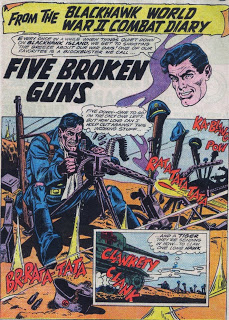
One of the things I love about this era of Blackhawk comics is when the series would occasionally remind readers that this used to be a slam-bang war comic by digging back into the "World War II Combat Diary." This particular story, written by France Herron and drawn by Jack Sparling and Chuck Cuidera, is no exception.
The Blackhawks parachute into Nazi-occupied France in order to destroy a strategically important bridge, but the second they land, they come under unexpected Nazi fire.
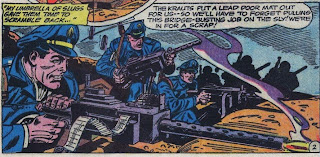
Man, I love the dialogue in this story.
The boys are pinned down, and they need to come up with a plan in order to save their own bacon and complete the mission. Blackhawk's solution: pretend that Andre and Stan were killed in a grenade blast, allowing the duo to flank the Nazis and destroy their Tiger Tank that's on its way.
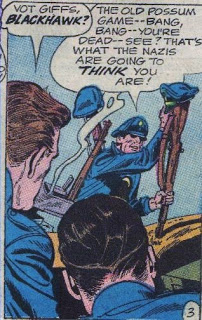
The Nazis increase the heat by calling in a mortar attack on the Blackhawks' trench, and realizing the team can't hold this position for long, Blackhawk extends his ruse by pretending that Chuck, Olaf, and Hendrickson are dead, too. The three are then sent to join their teammates in the tank attack.
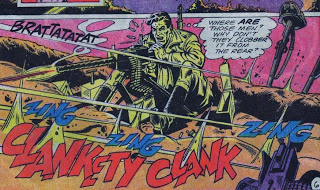
However, the tank keeps coming, and Blackhawk is having more and more difficulty holding his position. So, in typical Blackhawk style, the man takes matters into his own hands.
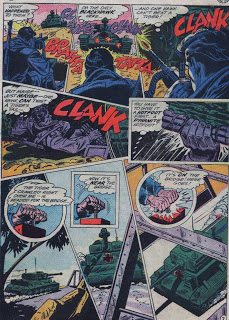
Just to be clear on what happens here: Blackhawk slides under the tank, attaches the dynamite, and then single-handedly blows up both the tank and the bridge--a job Blackhawk had previously sent 5 men to do. This is a pretty awesome sequence right here.
And where were the other Blackhawks while all this was going down?
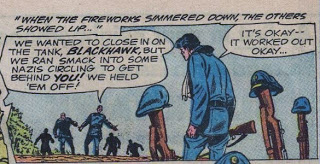
A likely story. As usual, the rest of the team drops the ball and leaves Blackhawk to do all the dirty work.

One of the things I love about this era of Blackhawk comics is when the series would occasionally remind readers that this used to be a slam-bang war comic by digging back into the "World War II Combat Diary." This particular story, written by France Herron and drawn by Jack Sparling and Chuck Cuidera, is no exception.
The Blackhawks parachute into Nazi-occupied France in order to destroy a strategically important bridge, but the second they land, they come under unexpected Nazi fire.

Man, I love the dialogue in this story.
The boys are pinned down, and they need to come up with a plan in order to save their own bacon and complete the mission. Blackhawk's solution: pretend that Andre and Stan were killed in a grenade blast, allowing the duo to flank the Nazis and destroy their Tiger Tank that's on its way.

The Nazis increase the heat by calling in a mortar attack on the Blackhawks' trench, and realizing the team can't hold this position for long, Blackhawk extends his ruse by pretending that Chuck, Olaf, and Hendrickson are dead, too. The three are then sent to join their teammates in the tank attack.

However, the tank keeps coming, and Blackhawk is having more and more difficulty holding his position. So, in typical Blackhawk style, the man takes matters into his own hands.

Just to be clear on what happens here: Blackhawk slides under the tank, attaches the dynamite, and then single-handedly blows up both the tank and the bridge--a job Blackhawk had previously sent 5 men to do. This is a pretty awesome sequence right here.
And where were the other Blackhawks while all this was going down?

A likely story. As usual, the rest of the team drops the ball and leaves Blackhawk to do all the dirty work.
Categories: Blogs of The Bureau Chiefs
Blackhawk Wingsday: A Firing Squad for Blackhawk

As I mentioned last week, Blackhawk 196 (May 1964) marks a major change in the series, as new writers Arnold Drake and France Herron took the team in a new direction (Dick Dillin and Chuck Cuidera remain on as artists). With this issue, the Blackhawks would no longer be involved in generic crimefighting on the domestic front; instead, their adventures would involve international espionage as they go to work for a secret UN agency under the lead of the mysterious and faceless Mr. Cipher.

Hey, Andre, be careful who you call "Frog"; that can boomerang on you.
The story begins with the team arriving at UN Headquarters after they have been called in for a special meeting with Mr. Cipher, who has a mission for them: they must go to the South American country of San Lajunta to capture a Japanese scientist named Sessue Yokomata, who is wanted for war crimes and believed to be making fantastic weapons for the brutal dictator of San Lajunta, Gonzagas.

Note another major change to the series evident in this panel: Hendrickson has been given some Grecian Formula.
Among Yokomata's fantastic machines are a giant eye and some kind of octopus machine, which we will see later.
The Blackhawks agree to take the mission, and they prepare to parachute into San Lajunta under cover of night. Andre, as usual, clearly has his mind in the game, as all he does is complain about the smell of the camouflage paint. Luckily for Andre, he is always prepared:

You see, Chop-Chop, Andre is always on the hunt for the ladies.
The team breaks their way in to Yokomata's camp, and, disguised in radiation suits, they take some quick films of the joint. However, they are quickly discovered, and Yokomata launches his giant bloodshot eye:

The team rendezvous at the assembly point, only to find their leader missing. They go back to the camp and discover a shocking surprise:

Blackhawk is now working for the enemy! Also, Yokomata is actually their old wartime enemy, Colonel Frog. It's nice to see that, while the series is being taken in a new direction, the creators haven't lost sight of the series' core quality: unapologetic, blatant racism. Especially against Asians.
It turns out, Yokomata/Colonel Frog was only pretending to work for Gonzagas, but in reality, the Japanese scientist was using the dictator's resources to create machines to take over San Lajunta himself.
The Blackhawks attack Frog's infernal devices, and they succeed in destroying the octopus thingy and freeing Blackhawk. However, they don't realize until it's too late that Blackhawk is still under the sway of Colonel Frog, and they are led into a trap that causes them to become Frog's slaves as well.

Blackhawk even makes an announcement to the world that Yokomata has taken over San Lajunta, and they are now making their way to conquer the neighboring country of Carbonda. Meanwhile, word gets back to Mr. Cipher that the team has failed, so he orders an attack on the Blackhawks.
Blackhawk fights off the attack in another of Frog's experimental aircraft. While attempting to escape, Blackhawk takes the plane high into the stratosphere, but that causes his cabin pressure to drop dramatically. Blackhawk passes out, but recovers himself in time to correct the dive. He also discovers that the pressure drop somehow caused him to be cleaned out of Frog's hypnotic gas, and he is now completely in control of himself.
Frog, however, has figured out that Blackhawk is free, so he sics the other team members on him. Blackhawk manages to lure the team into a pressure chamber that's being used to prepare soldiers for space missions, and he frees them of the gas's influence as well.
Nonetheless, they pretend to still be under Frog's control, and Frog wants them to execute Blackhawk by firing squad. Then, things get complicated:

Don't fret. Blackhawk isn't dead--he had another backup plan, which involved creating a makeshift bulletproof vest out of the octopus's windshield. Blackhawk then shoots Yokomata in the hand and captures the would-be dicator.
When the team returns to the US, they find that Mr. Cipher is very pleased with their success, despite the fact that they stumbled on to it through dumb luck.

Thus, a new status quo is established for the Blackhawks, as they become agents of the UN.
This story is likely written by Arnold Drake, and a second story in the issue, which flashes back to World War II, is by France Herron. More changes were to come for the team in the following months, beginning a long period of shakeups where DC editorial tried to figure out what to do with this series. Reconfiguring the team as Cold War spies, though, makes a lot of sense, and it definitely gives the series a clear purpose that it had been missing for about ten years.

Categories: Blogs of The Bureau Chiefs
The Gil Kane Punch of the Week 30: What's Batman Got that I Haven't?
The Gil Kane Punch took last week off while I was compiling the year-end/decade-end lists (and I still have one more list to do). So, to make up for lost time, here's a special super-sized edition of the Gil Kane Punch of the Week!
In "Peril of the Powerless Green Lantern!" from Green Lantern 58 (Jan. 1968, reprinted in Showcase Presents Green Lantern Vol. 3)-- written by Gardner Fox, pencilled by Gil Kane, and inked by Sid Greene--the Guardians of the Universe remove Hal Jordan's power ring and force him to take a vacation after some erratic emotional behavior threatens his role as a galactic law enforcement officer. The absence of a power ring, however, does not stop Hal from finding some action:
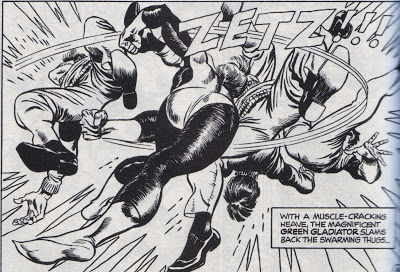
While confronting one gang, the thugs quickly recognize that GL is sans power ring, so they all gang up on them, but Hal takes four of them down with one "muscle-cracking heave," to quote Gardner Fox's purple prose.
With this next move, though, I don't even know how it would work physically:
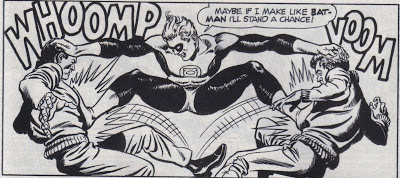
You would have to be extra bendy to simultaneously grab two guys by the head and kick them in the guts. But there it is.
Missing his normal powers, GL has to rely on his basic fighting skills and brute strength, causing him to channel Batman. While asking the eternal question, WWBD?, Hal turns introspective and starts to make some broader comparisons between himself and the Dark Knight:
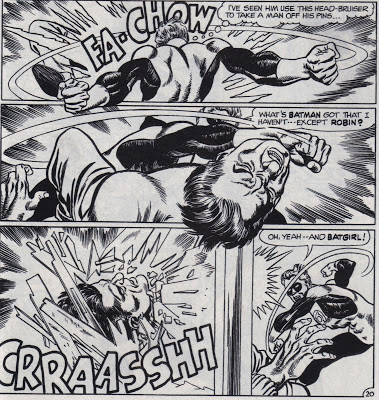
I also want to point out, earlier in this story, Hal spends a page and a half beating the shit out of a bear. I'm going to be spending some more time with Green Lantern 58 over the coming weeks, when I'll be sure to share the awesome experience of the Gil Kane Bear Punch!
In "Peril of the Powerless Green Lantern!" from Green Lantern 58 (Jan. 1968, reprinted in Showcase Presents Green Lantern Vol. 3)-- written by Gardner Fox, pencilled by Gil Kane, and inked by Sid Greene--the Guardians of the Universe remove Hal Jordan's power ring and force him to take a vacation after some erratic emotional behavior threatens his role as a galactic law enforcement officer. The absence of a power ring, however, does not stop Hal from finding some action:

While confronting one gang, the thugs quickly recognize that GL is sans power ring, so they all gang up on them, but Hal takes four of them down with one "muscle-cracking heave," to quote Gardner Fox's purple prose.
With this next move, though, I don't even know how it would work physically:

You would have to be extra bendy to simultaneously grab two guys by the head and kick them in the guts. But there it is.
Missing his normal powers, GL has to rely on his basic fighting skills and brute strength, causing him to channel Batman. While asking the eternal question, WWBD?, Hal turns introspective and starts to make some broader comparisons between himself and the Dark Knight:

I also want to point out, earlier in this story, Hal spends a page and a half beating the shit out of a bear. I'm going to be spending some more time with Green Lantern 58 over the coming weeks, when I'll be sure to share the awesome experience of the Gil Kane Bear Punch!
Categories: Blogs of The Bureau Chiefs
Blackhawk Wingsdays: Blackie Makes a Comment on the Cold Weather that's Currently Gripping the Nation
As I mentioned in the last Blackhawk Wingsday post, the Blackhawks' mascot, Blackie, was given an education and consciousness in the stories, so that he would often come to the team's rescue when they needed his help. As his character developed in the story, he was also occasionally given his own one-page humor strips, drawn by the great Henry Boltinoff, who was responsible for many of the humor strips that ran in 60s DC Comics.
In this strip, from Blackhawk 196, Blackie just happens to be hanging out in the woods when an escaped con comes by, and the hawk decides to take matters into his own hands...or beak.
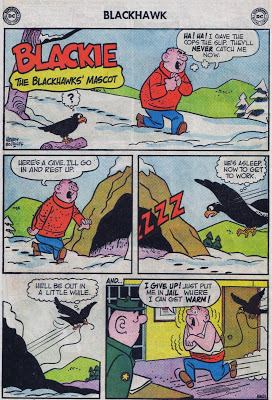
This con must have a load of confidence that the cops he escaped from are incompetent, because I can't imagine it would be all that difficult to follow his tracks in the snow all the way to the cave.
Also, Blackie is kind of lucky that his plan worked. I mean, instead of rushing off to jail to get warm, the con could have broken into a nearby farmhouse and taken a family hostage or something. There are a lot of ways this whole thing could have gone really bad.
This strip is not the only thing going on in this issue, however. Blackhawk 196 is an important turning point in this series, so I will be spending a lot of time on it in the next few weeks. For one, the creators start getting credited on a regular basis. Also, the Blackhawks get a new ongoing mission that helps define the team better than the random crime fighters that they had been for many years. But all that will have to wait until next week.
In this strip, from Blackhawk 196, Blackie just happens to be hanging out in the woods when an escaped con comes by, and the hawk decides to take matters into his own hands...or beak.

This con must have a load of confidence that the cops he escaped from are incompetent, because I can't imagine it would be all that difficult to follow his tracks in the snow all the way to the cave.
Also, Blackie is kind of lucky that his plan worked. I mean, instead of rushing off to jail to get warm, the con could have broken into a nearby farmhouse and taken a family hostage or something. There are a lot of ways this whole thing could have gone really bad.
This strip is not the only thing going on in this issue, however. Blackhawk 196 is an important turning point in this series, so I will be spending a lot of time on it in the next few weeks. For one, the creators start getting credited on a regular basis. Also, the Blackhawks get a new ongoing mission that helps define the team better than the random crime fighters that they had been for many years. But all that will have to wait until next week.
Categories: Blogs of The Bureau Chiefs
Dr. K's 10 Favorite Comics of 2009!
After covering my favorite movies of the decade, I'm now moving on to my favorite superhero comics of the year. I'll have one more list this week with my favorite original graphic novels of the year coming up later.
First, though, a couple of things not on this list that probably should be. This year, I switched to trades on Invincible Iron Man and The Incredible Hercules, mainly because I found that I was getting more enjoyment out of the series reading complete story arcs, while finding it much less satisfying to follow these series from month to month. Also, when Marvel switched both Incredible Hercules and Agents of Atlas to biweekly schedules, it just became too cost-prohibitive to keep following both series. But, as it stands, I haven't read the 2009 issues of Iron Man and Herc, so they didn't make my list, though they probably would have otherwise.
Another Marvel series that ranked highly last year fell off the list: Captain America. I think the regular issues of this series were good enough this year to make the list, but I've been disappointed with the Reborn miniseries, which has been moving too slow to get to a fairly inevitable conclusion. And now that the series has been extended an issue for no good reason--compressing the early chapters to hit all the important story points in five issues would have been the preferable route--I'm inclined to leave Cap off my list this time.
Also, I toyed with the idea of putting Wednesday Comics in the number 10 spot, as several of the strips, including Kamandi, Strange Adventures, Metamorpho, and the Flash were among the best comics I read this year, but taken as a whole, there were enough weaker strips, like Wonder Woman, Superman, and the Teen Titans, to shift the balance.
Anyway, here's the list of my ten favorite superhero comics of the year, in reverse order:
10. Captain Britain and MI13
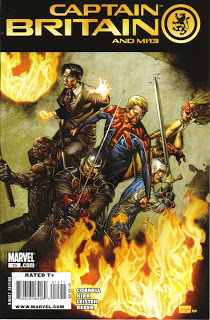
One trend you'll see on this list is good series that were cancelled this year. I'm not really going to speculate much on the market forces that caused these series to fail, but it was disappointing to see several awesome series that were heading in interesting directions get the axe. One of these was Paul Cornell and Leonard Kirk's Captain Britain and MI13, which had in 2009 a great storyline about Dracula's attempt to take over England from his base on the moon. This series was filled with crazy ideas from Paul Cornell, who spun this book out of his Pete Wisdom miniseries from a couple of years ago. One thing I loved about this series, and what made it fun to read from month to month, was how Cornell would put the team into situations from which it seemed impossible to escape. Then, we'd find out later that Pete Wisdom had the whole thing under control all along, and it didn't feel like cheating. Also, each character on the team had their own individual subplots which were prematurely stopped when the series was cancelled with issue 15. I do hope that we get to see Cornell return to these characters in 2010.
9. Dominic Fortune
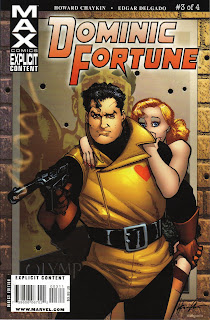
I've been a Howard Chaykin fan since American Flagg! first came out and I was way too young to be reading it. This year's Dominic Fortune miniseries from Marvel's Max imprint felt like it came straight from that era, as if Chaykin had not missed a beat. Fortune, a pulp-era mercenary that Chaykin created for Marvel back in the 70s, is the prototype for most later Chaykin heroes, and it hits all the points one would expect with the creator: randy, oversexed hero; beautiful women; nice period detail; and anti-Semitic villain bent on destroying America. This series may, in fact, be nothing new from Chaykin, but it's still fun to watch a master do what he does best.
8. Madame Xanadu
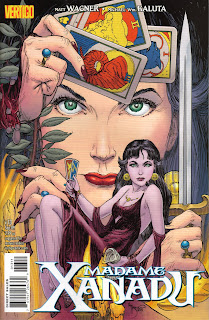
This series made my list last year, and it's still going strong this year, with the conclusion of the opening story arc, another drawn by the great Michael Wm. Kaluta, and a current arc set in the 50s, with the return of artist Amy Reeder Hadley. Writer Matt Wagner is getting to play in the larger playground of DC's mystical heroes, which is normally off-limits in the Vertigo line, so it feels like this series could easily fit into the DC universe proper. The Kaluta story even reunited Wagner with the Golden Age Sandman, which was nice to see for any fan of Sandman Mystery Theatre. The current storyline feels a bit like "What if Betty Draper from Mad Men were were possessed by Morgaine le Fey?" which, on its own, is a great hook for a story. And even though Wagner is playing out these stories in long arcs (the first went 10 issues, and the current one is promised to go at least 8), it's still a series that holds my interest from month to month. So, while I've switched to trades on almost every other Vertigo book, I'm still keeping this on my pull list.
7. Booster Gold
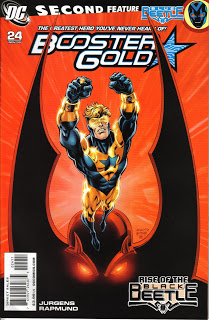
After Geoff Johns and Jeff Katz left this book following the first year, original creator Dan Jurgens has really kept this series going, maintaining a fun, high-adventure tone to the book. If readers are looking for fun superhero comics from DC, this is the best there is, with the hero solving time-related problems throughout the history of the DC universe. And, as an added bonus, Matt Sturges and Mike Norton are doing a great job with the Blue Beetle co-feature, maintaining the momentum Sturges had built when that regular series was cancelled last year (though this co-feature is said to be ending soon). I'm also a big fan of Dan Jurgens's art--few artists do classic, dynamic action as well as Jurgens.
6. Agents of Atlas
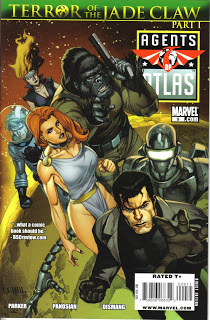
This is another series cancelled too early, though Marvel has done a lot to keep this property alive, with X-Men and Avengers crossover miniseries and guest appearances in other books. With his work on this series and the miniseries that preceded it, Jeff Parker is on my list of writers whose work I follow no matter what. With this series, Parker has created a team book that's fun to read because the team gets along with each other so well, and the series doesn't have to rely on annoying antagonism between team members to create artificial tension. I also enjoyed how this series fit in so well with the overall Dark Reign storyline going on in the Marvel universe,with the Atlas Corporation pissing off Norman Osborn after intentionally botching an arms deal. I hope that Marvel's attempts to generate interest in these characters pays off, because I'd love to see this series come back for another go.
Also, I would add, this series introduced me to the work of artist Gabriel Hardman, who has since done some bang-up work for Marvel.
5. The Mighty
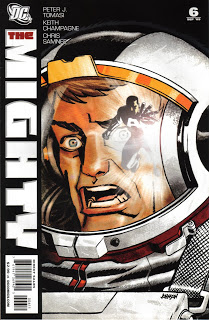
The last of the prematurely cancelled series, and the one that probably had the least chance of surviving from the get-go. There have been a lot of Superman analogs over the past few years, including good work that Mark Waid is doing at Boom!, but The Mighty felt like it could be the premise for an awesome TV series, and writers Peter Tomasi and Keith Champagne paced it as such, starting with a fantastic first issue that read like a great pilot episode and had me hooked from the get-go. This was the one series that I couldn't wait to read from month to month because the writers kept ending each issue with an unbelievable cliffhanger while also creating a slow-burn of tension throughout the series. We start to get the inkling early on that something is not right with Alpha One, the world's only superhero, and as more and more information is revealed about just how screwed up he is, the more the reader is left wondering about how this story gets resolved. In the years to come, this will be one series that readers will be looking for in dollar bins, as it makes for a very satisfying 12 issues of comics.
I'd also point out that artist Chris Samnee has done a kick-ass job on the art, seamlessly taking over from orignal artist Peter Snejberg. Samnee's clean style makes Alpha One look like a classic superhero, which adds to the story's intensity when we find out that he's anything but. Samnee is another artist that I will be following in 2010, and I hope his profile increases from this great work.
4. Fantastic Four
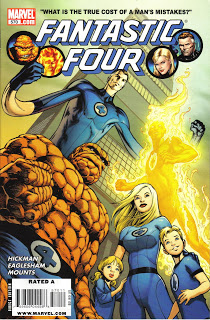
Growing up, I was more of a DC reader than a Marvel one, so I don't tend to have nostalgic attachments to Marvel characters. However, Marvel has been luring me over to their comics more and more due to the strength of the writers they've been putting on their books. In addition to Matt Fraction on Iron Man, one of the best match-ups this year has been Jonathan Hickman on Fantastic Four (Hickman is also doing a great job on Secret Warriors, though that book has been a bit bogged down in continuity from the Avengers books in recent issues, making it difficult to follow on its own.). Following a great Dark Reign: Fantastic Four miniseries, in which Hickman laid the groundwork for his run on the regular series, Hickman has focused in on the family element of the team. One of the biggest surprises of that focus is how much fun Franklin and Val are--Hickman gets these kids as kids, instead of as precocious adults, even though Val is technically smarter than any character in this book. In addition, the first "Solve Everything" arc had some great ideas involving the multiversal team of Reed Richardses, and the setup for the long haul on this series seems promising.
3. The Unwritten
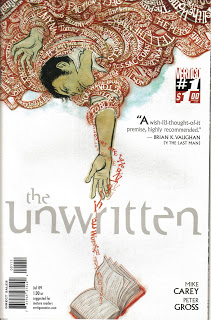
Mike Carey and Peter Gross's The Unwritten feels like the natural successor of the great supernatural books from Vertigo. So far, it's teased out just enough information about what is going on in the life of Tommy Taylor--the son of the writer of a popular children's series that looks a lot like Harry Potter--to keep things interesting and allay confusion. I also like how Carey has structured this series around story arcs that are punctuated by single issues that reveal the impact of the story's overall conspiracy on the history of literature. This series combines the best parts of Sandman and Fables, as well as Carey and Gross's other great series, Lucifer. In that sense, this series fills a gap in the Vertigo line, and I hope this becomes the next popular franchise from there, as Carey's premise seems to have unlimited potential.
2. Batman and Robin
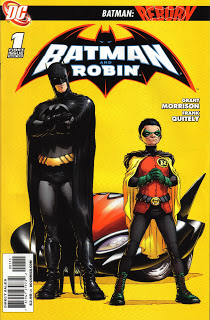
Much has already been said about the fact that Bruce Wayne is missing from the main Batman titles, yet this year has seen some fantastic Batman comics nonetheless (I would include here Judd Winick's run on the main Batman title, where he capitalized on the interesting dynamic between Alfred and Dick Grayson that has developed out of the absence of Bruce Wayne while also showing how easy it could be for some of Batman's major villains to realize that a new Batman was in the costume). Grant Morrison showed just how much potential entertainment there could be in having a more fun-loving Batman teaming up with a darker, more intense Robin. I'm also enjoying the heck out of all the new villains Morrison has created for Batman so far. In addition, Frank Quitely's art on the first three issues shows a dynamism and experimentation that pushes his work to new heights. In fact, it is only Philip Tan's rather problematic art on the second arc that keeps this book out of the number one spot.
1. Detective Comics
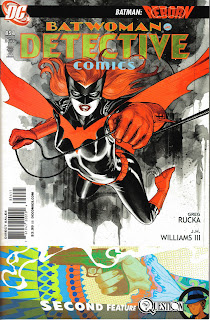
Years from now, we're going to be talking about Greg Rucka and J. H. Williams III's Batwoman series as one of the high points of the superhero genre. Williams's art is frankly amazing here, and Rucka is writing stories that capitalize on the artist's incredible design sense and his ability to change styles to suit the tone and action of a given scene (also, Dave Stewart's coloring is a perfect fit for Williams's art, seamlessly shifting along with the artist's style changes). It was a bold move on DC's part to turn over its flagship title to this character, but in doing so, they have helped create a work of lasting importance and are giving it a larger audience than it might have had on its own (though I am looking forward to the promised Batwoman regular series to come).
The Question backup, with nice art by Cully Hamner has also been a great read. I had previously been disappointed with the Renee Montoya incarnation of this character, but this story finally taps into the character's potential. Rucka proves with this comic that he's great with writing stories that fit his artist's strengths, and Cully Hamner draws some great fight sequences. With these two stories running in each issue, Detective Comics is simply the best comic on the market right now.
Feel free to comment on some of the comics you liked this year, especially if it's something I didn't pick up!
First, though, a couple of things not on this list that probably should be. This year, I switched to trades on Invincible Iron Man and The Incredible Hercules, mainly because I found that I was getting more enjoyment out of the series reading complete story arcs, while finding it much less satisfying to follow these series from month to month. Also, when Marvel switched both Incredible Hercules and Agents of Atlas to biweekly schedules, it just became too cost-prohibitive to keep following both series. But, as it stands, I haven't read the 2009 issues of Iron Man and Herc, so they didn't make my list, though they probably would have otherwise.
Another Marvel series that ranked highly last year fell off the list: Captain America. I think the regular issues of this series were good enough this year to make the list, but I've been disappointed with the Reborn miniseries, which has been moving too slow to get to a fairly inevitable conclusion. And now that the series has been extended an issue for no good reason--compressing the early chapters to hit all the important story points in five issues would have been the preferable route--I'm inclined to leave Cap off my list this time.
Also, I toyed with the idea of putting Wednesday Comics in the number 10 spot, as several of the strips, including Kamandi, Strange Adventures, Metamorpho, and the Flash were among the best comics I read this year, but taken as a whole, there were enough weaker strips, like Wonder Woman, Superman, and the Teen Titans, to shift the balance.
Anyway, here's the list of my ten favorite superhero comics of the year, in reverse order:
10. Captain Britain and MI13

One trend you'll see on this list is good series that were cancelled this year. I'm not really going to speculate much on the market forces that caused these series to fail, but it was disappointing to see several awesome series that were heading in interesting directions get the axe. One of these was Paul Cornell and Leonard Kirk's Captain Britain and MI13, which had in 2009 a great storyline about Dracula's attempt to take over England from his base on the moon. This series was filled with crazy ideas from Paul Cornell, who spun this book out of his Pete Wisdom miniseries from a couple of years ago. One thing I loved about this series, and what made it fun to read from month to month, was how Cornell would put the team into situations from which it seemed impossible to escape. Then, we'd find out later that Pete Wisdom had the whole thing under control all along, and it didn't feel like cheating. Also, each character on the team had their own individual subplots which were prematurely stopped when the series was cancelled with issue 15. I do hope that we get to see Cornell return to these characters in 2010.
9. Dominic Fortune

I've been a Howard Chaykin fan since American Flagg! first came out and I was way too young to be reading it. This year's Dominic Fortune miniseries from Marvel's Max imprint felt like it came straight from that era, as if Chaykin had not missed a beat. Fortune, a pulp-era mercenary that Chaykin created for Marvel back in the 70s, is the prototype for most later Chaykin heroes, and it hits all the points one would expect with the creator: randy, oversexed hero; beautiful women; nice period detail; and anti-Semitic villain bent on destroying America. This series may, in fact, be nothing new from Chaykin, but it's still fun to watch a master do what he does best.
8. Madame Xanadu

This series made my list last year, and it's still going strong this year, with the conclusion of the opening story arc, another drawn by the great Michael Wm. Kaluta, and a current arc set in the 50s, with the return of artist Amy Reeder Hadley. Writer Matt Wagner is getting to play in the larger playground of DC's mystical heroes, which is normally off-limits in the Vertigo line, so it feels like this series could easily fit into the DC universe proper. The Kaluta story even reunited Wagner with the Golden Age Sandman, which was nice to see for any fan of Sandman Mystery Theatre. The current storyline feels a bit like "What if Betty Draper from Mad Men were were possessed by Morgaine le Fey?" which, on its own, is a great hook for a story. And even though Wagner is playing out these stories in long arcs (the first went 10 issues, and the current one is promised to go at least 8), it's still a series that holds my interest from month to month. So, while I've switched to trades on almost every other Vertigo book, I'm still keeping this on my pull list.
7. Booster Gold

After Geoff Johns and Jeff Katz left this book following the first year, original creator Dan Jurgens has really kept this series going, maintaining a fun, high-adventure tone to the book. If readers are looking for fun superhero comics from DC, this is the best there is, with the hero solving time-related problems throughout the history of the DC universe. And, as an added bonus, Matt Sturges and Mike Norton are doing a great job with the Blue Beetle co-feature, maintaining the momentum Sturges had built when that regular series was cancelled last year (though this co-feature is said to be ending soon). I'm also a big fan of Dan Jurgens's art--few artists do classic, dynamic action as well as Jurgens.
6. Agents of Atlas

This is another series cancelled too early, though Marvel has done a lot to keep this property alive, with X-Men and Avengers crossover miniseries and guest appearances in other books. With his work on this series and the miniseries that preceded it, Jeff Parker is on my list of writers whose work I follow no matter what. With this series, Parker has created a team book that's fun to read because the team gets along with each other so well, and the series doesn't have to rely on annoying antagonism between team members to create artificial tension. I also enjoyed how this series fit in so well with the overall Dark Reign storyline going on in the Marvel universe,with the Atlas Corporation pissing off Norman Osborn after intentionally botching an arms deal. I hope that Marvel's attempts to generate interest in these characters pays off, because I'd love to see this series come back for another go.
Also, I would add, this series introduced me to the work of artist Gabriel Hardman, who has since done some bang-up work for Marvel.
5. The Mighty

The last of the prematurely cancelled series, and the one that probably had the least chance of surviving from the get-go. There have been a lot of Superman analogs over the past few years, including good work that Mark Waid is doing at Boom!, but The Mighty felt like it could be the premise for an awesome TV series, and writers Peter Tomasi and Keith Champagne paced it as such, starting with a fantastic first issue that read like a great pilot episode and had me hooked from the get-go. This was the one series that I couldn't wait to read from month to month because the writers kept ending each issue with an unbelievable cliffhanger while also creating a slow-burn of tension throughout the series. We start to get the inkling early on that something is not right with Alpha One, the world's only superhero, and as more and more information is revealed about just how screwed up he is, the more the reader is left wondering about how this story gets resolved. In the years to come, this will be one series that readers will be looking for in dollar bins, as it makes for a very satisfying 12 issues of comics.
I'd also point out that artist Chris Samnee has done a kick-ass job on the art, seamlessly taking over from orignal artist Peter Snejberg. Samnee's clean style makes Alpha One look like a classic superhero, which adds to the story's intensity when we find out that he's anything but. Samnee is another artist that I will be following in 2010, and I hope his profile increases from this great work.
4. Fantastic Four

Growing up, I was more of a DC reader than a Marvel one, so I don't tend to have nostalgic attachments to Marvel characters. However, Marvel has been luring me over to their comics more and more due to the strength of the writers they've been putting on their books. In addition to Matt Fraction on Iron Man, one of the best match-ups this year has been Jonathan Hickman on Fantastic Four (Hickman is also doing a great job on Secret Warriors, though that book has been a bit bogged down in continuity from the Avengers books in recent issues, making it difficult to follow on its own.). Following a great Dark Reign: Fantastic Four miniseries, in which Hickman laid the groundwork for his run on the regular series, Hickman has focused in on the family element of the team. One of the biggest surprises of that focus is how much fun Franklin and Val are--Hickman gets these kids as kids, instead of as precocious adults, even though Val is technically smarter than any character in this book. In addition, the first "Solve Everything" arc had some great ideas involving the multiversal team of Reed Richardses, and the setup for the long haul on this series seems promising.
3. The Unwritten

Mike Carey and Peter Gross's The Unwritten feels like the natural successor of the great supernatural books from Vertigo. So far, it's teased out just enough information about what is going on in the life of Tommy Taylor--the son of the writer of a popular children's series that looks a lot like Harry Potter--to keep things interesting and allay confusion. I also like how Carey has structured this series around story arcs that are punctuated by single issues that reveal the impact of the story's overall conspiracy on the history of literature. This series combines the best parts of Sandman and Fables, as well as Carey and Gross's other great series, Lucifer. In that sense, this series fills a gap in the Vertigo line, and I hope this becomes the next popular franchise from there, as Carey's premise seems to have unlimited potential.
2. Batman and Robin

Much has already been said about the fact that Bruce Wayne is missing from the main Batman titles, yet this year has seen some fantastic Batman comics nonetheless (I would include here Judd Winick's run on the main Batman title, where he capitalized on the interesting dynamic between Alfred and Dick Grayson that has developed out of the absence of Bruce Wayne while also showing how easy it could be for some of Batman's major villains to realize that a new Batman was in the costume). Grant Morrison showed just how much potential entertainment there could be in having a more fun-loving Batman teaming up with a darker, more intense Robin. I'm also enjoying the heck out of all the new villains Morrison has created for Batman so far. In addition, Frank Quitely's art on the first three issues shows a dynamism and experimentation that pushes his work to new heights. In fact, it is only Philip Tan's rather problematic art on the second arc that keeps this book out of the number one spot.
1. Detective Comics

Years from now, we're going to be talking about Greg Rucka and J. H. Williams III's Batwoman series as one of the high points of the superhero genre. Williams's art is frankly amazing here, and Rucka is writing stories that capitalize on the artist's incredible design sense and his ability to change styles to suit the tone and action of a given scene (also, Dave Stewart's coloring is a perfect fit for Williams's art, seamlessly shifting along with the artist's style changes). It was a bold move on DC's part to turn over its flagship title to this character, but in doing so, they have helped create a work of lasting importance and are giving it a larger audience than it might have had on its own (though I am looking forward to the promised Batwoman regular series to come).
The Question backup, with nice art by Cully Hamner has also been a great read. I had previously been disappointed with the Renee Montoya incarnation of this character, but this story finally taps into the character's potential. Rucka proves with this comic that he's great with writing stories that fit his artist's strengths, and Cully Hamner draws some great fight sequences. With these two stories running in each issue, Detective Comics is simply the best comic on the market right now.
Feel free to comment on some of the comics you liked this year, especially if it's something I didn't pick up!
Categories: Blogs of The Bureau Chiefs
Dr. K's Ten Favorite Movies of the Twenty-First Century!
Over the next week or so, I'm going to indulge in one of those New Year activities that having a blog affords me: top ten lists. My first list involves a fairly big task I've been thinking about for the past month or so: my favorite movies of the decade from 2000-2009.
I normally don't do annual film lists because I live in an area where the most acclaimed movies of the year don't arrive in theaters until January or February, if they arrive at all before DVD release. Plus, this year, I just didn't see that many new movies.
In comprising my best-of-the-century-so-far list, I put together a short list of films that I thought could make the list. So, before I get to the top ten, here's a list of films that didn't make it, in no particular order:
Shaun of the Dead, Syriana, Mulholland Drive, The Departed, Being John Malkovich, 28 Days Later, The Lives of Others, Star Trek, Iron Man, The Lord of the Rings Trilogy, The Bourne Supremacy, The Bourne Ultimatum, Lost in Translation, Kill Bill Vols. 1 and 2, Gosford Park, The Royal Tennenbaums, The Beat that My Heart Skipped, Blackhawk Down, The Woman Chaser, Role Models, Le Petit Lieutenant, All the Real Girls, and Lantana.
Two movies popped on and off the list, tempting me to cheat by calling a tie or two. In fact, both of the movies would have made the list if I had not suddenly remembered two other movies at the last minute. Amélie and City of God, therefore, deserve some special mention here. I'm a total sucker for Amélie, despite the fact that I know I'm being emotionally manipulated the whole time. And, with City of God, if I just watched the movie a few more times, it would probably creep up on my list. As a film teacher, I often get students and colleagues approaching me about films they recently saw, and no film of the last few years seems to have inspired such ecstatic proselytizing as City of God.
With that out of the way , here's the list in reverse order:
10. Michael Clayton
In my grumpy old man moments, I like to imagine a world in which Hollywood made more movies that catered to an intelligent, adult audience like Michael Clayton does. The movie feels like what movies would be like if the Hollywood blockbuster era never happened, and you could draw a straight line from the 70s movies of Robert Altman, Sidney Lumet, Hal Ashby, and so on to this. Tony Gilroy takes what could easily be an inspiring TV-movie plot and turns it into a smart movie, helped along by some amazing performances. I could also spend a lot of time just praising George Clooney's career choices throughout the decade because, more than any other actor, he's making movies that I want to see.
9. Inglourious Basterds
I went into this movie expecting to see Brad Pitt lead a bunch of Jewish soldiers in killing Nazis for three hours, and I would have been perfectly happy seeing that movie. But "that movie" is actually the Allies equivalent of Nation's Pride, the Nazi propaganda film-within-the-film of Inglourious Basterds. Instead, Quentin Tarantino gives us a suspenseful, multilayered narrative that capitalizes on the promised maturity of Jackie Brown, while also satisfying the need to see some Nazis get killed.
8. Caché (Hidden)
Michael Haneke is a filmmaker who normally angers me despite the fact that I respect the commentaries he often makes on voyeurism and violence (see both versions of Funny Games). However, in this tightly wound thriller, he makes the viewer think about his or her complicity in what happens on-screen without the excessive didacticism that tries to prove that we are all bad people. Instead, the violent scene at the crux of this movie and the near-overwhelming sense of tension that builds up to it and follows it manage to be shocking to the most jaded audience. And if one can bear a return visit, the film rewards multiple viewings with more "hidden" information about the relations between these characters who have such a tragic impact on each others' lives. After seeing this movie for the first time, I've sensed a shift in the way I respond to film violence, and the way it genuinely accomplishes its tension highlights the artifice of most contemporary thrillers.
7. Brick
I love the film noir genre, and I especially enjoy seeing how the genre gets revised from generation to generation. Brick, a noir film set in a contemporary high school but featuring dialogue that seems to come straight from the classic film noir cycle of the 40s and 50s, seems to be a perfect example of what could be done to move the genre forward while still keeping a nostalgic eye on the past. On my first viewing, I watched the movie twice in a row, just luxuriating in the fabulous, sharp dialogue. I really want to see more movies like this. Also, this movie contains one of the most inspired casting choices of the decade: Richard "Shaft" Roundtree plays the high school principal.
6. Oldboy
Unlike other movies on this list, Oldboy is a movie I've only watched once, and I'm perfectly fine with that. The plot, about a man who is held prisoner for 15 years and no apparent reason and then seeks revenge on his captor, is a blast, and director Park Chan-wook choreographs some of the best action scenes of the decade. But it's the last 30 minutes or so, where the mysteries of the plot start to get revealed, that had me shaking my head in astonishment as I couldn't believe what was happening, even though it made perfect sense in the world that Park created.
5. There Will Be Blood
I would cite my experience seeing this movie as the best film-going experience I had this decade. I saw it on a Thursday night--the very last screening of the film at the local theater. And I was the only one there. That allowed me to be uninhibited in my vocal responses to the film. But beyond that experience, later repeat viewings have proven that my initial appreciation wasn't wrong. It's over the top in every way, and Paul Thomas Anderson does have problems creating likeable characters, but none of that really detracts from the quality of this film, which is anchored by the best performance of the decade.
4. Children of Men
There were a lot of apocalyptic films made this decade, but most imagined a singular, catastrophic disaster bringing about the end of civilization. Children of Men imagines the end coming slowly and painfully through a world-wide fertility crisis. The world of 2027 that director Alfonso Cuaròn imagines also looks like an authentic world of the future, with technology only slightly more advanced than ours but still recognizeable. Alfonso Cuaròn also created two long takes that are among the most amazing put on film, and he uses his technical mastery in furtherance of a compelling, exciting, and moving story. I love showing this movie to students because they often come away from it with a sense that a movie can be both action-packed and intelligent, contrary to much of their experience.
3. The Dark Knight
A lot of the movies on this list are here partially because they represent the type of movie I'd like to see more of, or, more specifically, that I hope they mark the beginning of trends that change certain genres or inspire future filmmakers. But I really hope that's true of The Dark Knight: I wish that every big summer tentpole movie could be exciting while also not requiring the audience to leave their brains at the door (I would also mention that Star Trek accomplishes this, as well). Also, as anyone who reads this blog knows, I'm totally in the tank for Batman, and if I were really honest with myself, I'd put this at number 1.
2. No Country for Old Men
I love pretty much everything the Coen brothers have done this decade, but No Country for Old Men transcends their normal greatness. I just eat this movie up every time I watch it, and I particularly appreciate the bold choices the Coens made to leave some of the major climactic scenes off-screen, trusting the viewer to know exactly what happened without needing to see it. Also, Javier Bardem makes me both laugh and squirm whenever he's onscreen in this film. And though I know a lot of viewers hate it, I really love the ending.
1. In the Mood for Love
Another criterion I used in making this list was if the movie created a unique emotional experience that I had never felt in a movie before. To be honest, that often involved a reaction to movie violence. Wong Kar Wai's 2000 meditation on forbidden love and guilt, however, just wrecks me in a way that no other movie has. And I think it's a testament to the film's emotional power and authenticity that, every time I see it, I desperately hope things will work out differently for Mrs. Chan and Mr. Chow.
I love everything about this movie: the 60s Hong Kong milieu, the costumes, the music, the cinematography (especially the way in which the main characters' spouses are never shown), and the outstanding, touching performances by Maggie Cheung and Tony Leung Chiu Wai. At its heart, In the Mood for Love is a romantic movie about restraint and denial, which are subjects rarely broached in romances.
Up next: the top superhero comics of 2009!
Categories: Blogs of The Bureau Chiefs
Blackhawk Wingsdays: Tales of the Blackhawk Emblem!
A few weeks ago, I covered the lead story in Blackhawk 191(Dec. 1963), in which the Blackhawks fight the pantsless menace, the Molecule Man. As that issue's cover advertises "Two Big Stories," I would be remiss if I didn't finish out the entire issue. In addition, as the final Blackhawk Wingsday of 2009, this story shows exactly how Blackhawk would have dealt with one of the biggest news events of the year. It's an adventure ripped from the headlines 46 years in the future!
This story is actually a collection of three different Blackhawk adventures, all told from the point-of-view of both witnesses and participants in those adventures. These stories are ostensibly linked together by one particular element, as we can see by the story's title:
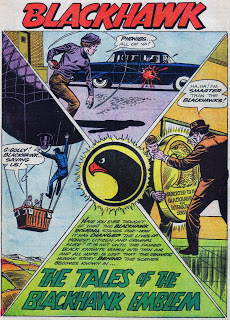
The caption on the splash page utilizes one of the most worn out strategies that I see in freshman composition papers every semester: the rhetorical question, "Have you ever thought of...." And, as in those cases, the answer to the question here is, "No." I have never thought about what the Blackhawk insignia stands for because it's an image of a black hawk. It seems pretty goddam obvious.
But not to some guy named Yates, who has just written a giant coffee table book with this title. Yates went around the country asking people what the Blackhawk emblem meant to them, and from those people who didn't chase him off with a shotgun or verbally abuse them, he managed to get enough material to make a book. Man, they will make a book out of anything.
We learn of the existence of this book after a traumatic newstory grips the nation: the Blackhawks have disappeared! Not all the Blackhawks are gone, however, as we see Zinda, the Lady Blackhawk, arrive at the local airport to announce that she's going to commence a search for her missing teammates. There, she's accosted by Yates, who asks her to check on the copy of his book that he gave the team, because clearly she has nothing better to do than to look for this guy's book.
Zinda returns to Blackhawk Island, where she is met by the two other remaining team members: Bravo, the Blackhawk monkey, and Blackie, the Blackhawk black hawk.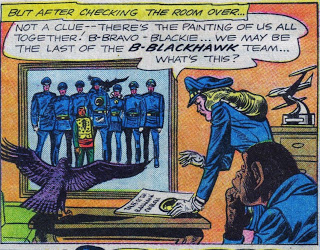 With nothing better to do, like investigate their teammates' disappearance, the three commence to reading Yates's book:
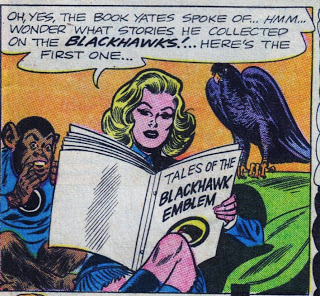
(By the way, it's been established in earlier Blackhawk stories that Blackie knows how to read. He can also spell his own name and write. I'm not sure what skills Bravo brings to the table. However, I did forget to mention last week that, when Batman goes to Blackhawk Island in the Batman Confidential story, "Blackhawk Down," he does fight Bravo's feral descendents, which is another nice touch that Royal McGraw included for Blackhawk fans.)
Yates's first story is told to him by a farmer named Bob Johnson, whose story is strikingly similar to one that gripped the nation not too long ago:
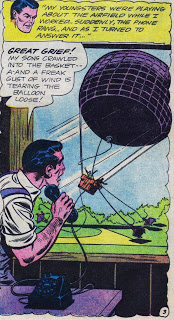
You know, when I was transfixed to my television during the whole "Balloon Boy" excitement, I constantly asked myself, "What would Blackhawk do in a situation like this?" Now, of course, we can find out for ourselves:
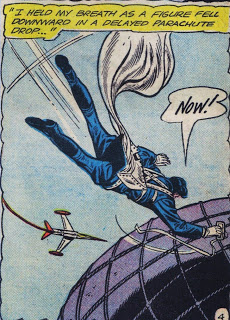
Of course, he would parachute out of his jet and land on top of the balloon. If only someone did this for Balloon Boy, most of us wouldn't have blown a whole day on something that turned out to be a hoax.
Blackhawk ends up rescuing the kids, and Farmer Bob concludes by explaining that the fact that his two sons are alive (and he is not in jail for reckless endangerment and child neglect) is what the Blackhawk emblem means to him. However, I'd like to point out to Farmer Bob that it wasn't the freaking Blackhawk emblem that risked its life to parachute out of a plan and land onto a moving balloon.
For the second story, Yates went to the County Correction Farm upstate to meet with Jim Dolan, who had once been a punk kid with a strong hatred for the Blackhawk emblem:
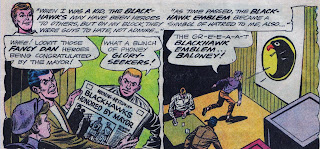
While the Blackhawks were heroes to most, they never meant shit to Jim Dolan and his friends, who probably also felt the same way about John Wayne.
When Jim and his buddies decide to take on a life of crime, their first heist--of a riverfront warehouse--is broken up by the Blackhawks. However, when Jim falls into the water and can't swim, his buddies take a powder, and it's Olaf who ends up saving the juvenile delinquent. Then, in a nice piece of irony, we find out that Jim Dolan is the coach at the correction farm, and not an inmate!
For the third story, Yates performs a prison interview with "Crafty" Craig, who may have got his nickname for his uncanny skills at knitting tea cozies and pot holders. Crafty and his gang had stolen a giant, solid gold Blackhawk emblem that had been given to the team by a "foreign nation" (i.e., Cuba), but he was quickly caught by the team. At the end of his narrative, he vows vengeance on the Blackhawks when he gets out of prison.
Setting down the book, Zinda notices that a bookmark is placed at the end of Craig's story, indicating that this is where the team stopped reading. Could there be a clue to their disappearance here?
Of course there is, because otherwise Zinda, Bravo, and Blackie would have been wasting their time reading this book while the rest of the Blackhawks may have been in mortal danger. With this realization, we then get a flashback to what happened when the Blackhawks were reading the book.
The team decides to investigate the threat made by Craig, who has recently been released from prison, by heading to the thief's island hideout. There, they all charge the gang, only to fall through a giant trap door.
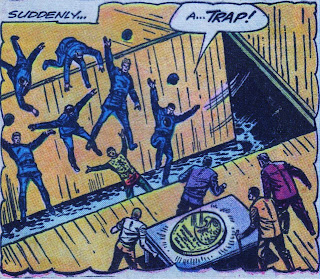
If anything signifies that the Blackhawks are a shitty crimefighting team (especially when they are out of their aerial element), it's the fact that all seven of them fell through the same goddam trap door.
We then cut to the present, where Craig reveals his plan to the team, who have been his prisoners for several days:
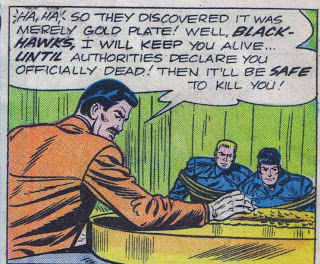
This plan does not make any sense.
To prove that the Blackhawks were captured by a bunch of total idiots, Zinda enacts her own plan to help the team escape:
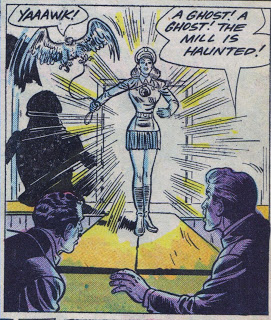
So, while she distracts the criminals by pretending to be a hawk-carrying ghost, Bravo comes in with a nail file to cut the heroes loose.
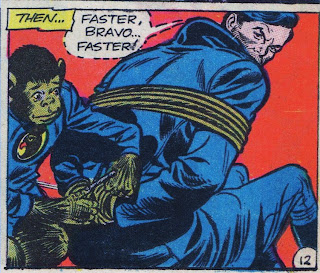
They then turn the tables on Crafty's gang, sending them down the trap door.
Zinda reveals that she defeated these idiots with three simple items found in any woman's purse (especially Joan Holloway's): face powder, a cigarette lighter, and a nail file. The irony of this story--from 1963 of course--is that the seven men were saved by the three "weakest" members of the team: a woman, a monkey, and a bird. However, the truth of the matter is that the Blackhawks suck so bad as crimefighters that they were almost killed by a gang who believed that a woman wearing face powder and carrying a cigarette lighter was a ghost. Seriously, if Crafty hadn't had the stupid plan to sit on the Blackhawks until they were declared dead, he could have killed them all and melted down their giant gold emblem, end of story. Then, the series could have been turned over to awesome stories of Lady Blackhawk, Bravo, and Blackie fighting crime.
This story is actually a collection of three different Blackhawk adventures, all told from the point-of-view of both witnesses and participants in those adventures. These stories are ostensibly linked together by one particular element, as we can see by the story's title:

The caption on the splash page utilizes one of the most worn out strategies that I see in freshman composition papers every semester: the rhetorical question, "Have you ever thought of...." And, as in those cases, the answer to the question here is, "No." I have never thought about what the Blackhawk insignia stands for because it's an image of a black hawk. It seems pretty goddam obvious.
But not to some guy named Yates, who has just written a giant coffee table book with this title. Yates went around the country asking people what the Blackhawk emblem meant to them, and from those people who didn't chase him off with a shotgun or verbally abuse them, he managed to get enough material to make a book. Man, they will make a book out of anything.
We learn of the existence of this book after a traumatic newstory grips the nation: the Blackhawks have disappeared! Not all the Blackhawks are gone, however, as we see Zinda, the Lady Blackhawk, arrive at the local airport to announce that she's going to commence a search for her missing teammates. There, she's accosted by Yates, who asks her to check on the copy of his book that he gave the team, because clearly she has nothing better to do than to look for this guy's book.
Zinda returns to Blackhawk Island, where she is met by the two other remaining team members: Bravo, the Blackhawk monkey, and Blackie, the Blackhawk black hawk.
 With nothing better to do, like investigate their teammates' disappearance, the three commence to reading Yates's book:

(By the way, it's been established in earlier Blackhawk stories that Blackie knows how to read. He can also spell his own name and write. I'm not sure what skills Bravo brings to the table. However, I did forget to mention last week that, when Batman goes to Blackhawk Island in the Batman Confidential story, "Blackhawk Down," he does fight Bravo's feral descendents, which is another nice touch that Royal McGraw included for Blackhawk fans.)
Yates's first story is told to him by a farmer named Bob Johnson, whose story is strikingly similar to one that gripped the nation not too long ago:

You know, when I was transfixed to my television during the whole "Balloon Boy" excitement, I constantly asked myself, "What would Blackhawk do in a situation like this?" Now, of course, we can find out for ourselves:

Of course, he would parachute out of his jet and land on top of the balloon. If only someone did this for Balloon Boy, most of us wouldn't have blown a whole day on something that turned out to be a hoax.
Blackhawk ends up rescuing the kids, and Farmer Bob concludes by explaining that the fact that his two sons are alive (and he is not in jail for reckless endangerment and child neglect) is what the Blackhawk emblem means to him. However, I'd like to point out to Farmer Bob that it wasn't the freaking Blackhawk emblem that risked its life to parachute out of a plan and land onto a moving balloon.
For the second story, Yates went to the County Correction Farm upstate to meet with Jim Dolan, who had once been a punk kid with a strong hatred for the Blackhawk emblem:

While the Blackhawks were heroes to most, they never meant shit to Jim Dolan and his friends, who probably also felt the same way about John Wayne.
When Jim and his buddies decide to take on a life of crime, their first heist--of a riverfront warehouse--is broken up by the Blackhawks. However, when Jim falls into the water and can't swim, his buddies take a powder, and it's Olaf who ends up saving the juvenile delinquent. Then, in a nice piece of irony, we find out that Jim Dolan is the coach at the correction farm, and not an inmate!
For the third story, Yates performs a prison interview with "Crafty" Craig, who may have got his nickname for his uncanny skills at knitting tea cozies and pot holders. Crafty and his gang had stolen a giant, solid gold Blackhawk emblem that had been given to the team by a "foreign nation" (i.e., Cuba), but he was quickly caught by the team. At the end of his narrative, he vows vengeance on the Blackhawks when he gets out of prison.
Setting down the book, Zinda notices that a bookmark is placed at the end of Craig's story, indicating that this is where the team stopped reading. Could there be a clue to their disappearance here?
Of course there is, because otherwise Zinda, Bravo, and Blackie would have been wasting their time reading this book while the rest of the Blackhawks may have been in mortal danger. With this realization, we then get a flashback to what happened when the Blackhawks were reading the book.
The team decides to investigate the threat made by Craig, who has recently been released from prison, by heading to the thief's island hideout. There, they all charge the gang, only to fall through a giant trap door.

If anything signifies that the Blackhawks are a shitty crimefighting team (especially when they are out of their aerial element), it's the fact that all seven of them fell through the same goddam trap door.
We then cut to the present, where Craig reveals his plan to the team, who have been his prisoners for several days:

This plan does not make any sense.
To prove that the Blackhawks were captured by a bunch of total idiots, Zinda enacts her own plan to help the team escape:

So, while she distracts the criminals by pretending to be a hawk-carrying ghost, Bravo comes in with a nail file to cut the heroes loose.

They then turn the tables on Crafty's gang, sending them down the trap door.
Zinda reveals that she defeated these idiots with three simple items found in any woman's purse (especially Joan Holloway's): face powder, a cigarette lighter, and a nail file. The irony of this story--from 1963 of course--is that the seven men were saved by the three "weakest" members of the team: a woman, a monkey, and a bird. However, the truth of the matter is that the Blackhawks suck so bad as crimefighters that they were almost killed by a gang who believed that a woman wearing face powder and carrying a cigarette lighter was a ghost. Seriously, if Crafty hadn't had the stupid plan to sit on the Blackhawks until they were declared dead, he could have killed them all and melted down their giant gold emblem, end of story. Then, the series could have been turned over to awesome stories of Lady Blackhawk, Bravo, and Blackie fighting crime.
Categories: Blogs of The Bureau Chiefs
The Gil Kane Punch of the Week 29: The Mightiest Haymaker of His Career!
For the final punch of 2009 (but, by no means, the final Gil Kane punch), I wanted to include something special. So, here's one of those rare and glorious moments: a full-page Gil Kane punch, from the story "Hunt for a Robin-Killer" in Detective Comics 374 (Apr. 1968; reprinted in Showcase Presents Batman Vol. 4), inked by Sid Greene.
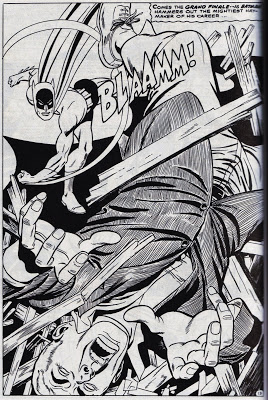
What makes this special, however, is not just the fact that it's a full-page Gil Kane punch, but also the hyperbole of writer Gardner Fox's caption for the panel. This isn't any old punch: this is "the mightiest haymaker of his career." Now, Batman has delivered a lot of punches in his career as a crimefighter. If we try to imagine for a moment what the mightiest haymaker Batman ever threw would be like, that imaginative activity would be the superhero equivalent of trying to imagine the number of angels that could dance on the head of a pin or a rock that God could create that would be too heavy for Him to lift. And who better to depict this mightiest punch than Gil Kane? (Well, maybe Jim Aparo, but that's for another series.)
But if anyone deserves to be on the receiving end of the mightiest haymaker of Batman's career, it's this guy, Jim Conders, a prize-fighter who set a trap that put Robin in the hospital. Conders then used his identical twin brother, Ed, to establish an alibi for himself and threatened to sue Batman for assault and false arrest. So, as you can imagine, this guy needed some big punching.
I hope you all have a Happy New Year. And, as Santa was kind enough to provide even more material for the Gil Kane Punch of the Week, you can rest assured that I resolve to continue providing Gil Kane Punches on into 2010!
Categories: Blogs of The Bureau Chiefs
Blackhawk Wingsdays: Blackhawk Down!

Batman Confidential 36-39 featured a contemporary update for the Blackhawks in a story with the inevitable title, "Blackhawk Down," written by Royal McGraw and drawn by Marcos Marz and Luciana del Negro. Along with the recent The Brave and the Bold story and the upcoming First Wave series, it signifies a kind of mini-renaissance for Blackhawk.
This story is a bit of a mixed bag, but I ended up liking it overall, mainly because McGraw clearly did his research, and he demonstrates a particular fondness for the Mark Evanier/Dan Spiegle run from the early 80s. In particular, the villain of this story is Ted Gaynor, the 8th Blackhawk introduced late in that series as a replacement for Chop-Chop, who takes a leave in order to fight the Japanese invasion of China. As Evanier wrote him, Gaynor is a total dick, and he ends up getting ostracized and ultimately kicked off the team for some rather extreme, uncompromising views.
Gaynor, who somehow survived World War II while also remaining youthful, has devised a plan to steal new technology from Blackhawk Industries (now run by Wu Cheng's/Chop-Chop's nephew), pin the theft on the Chinese, and spark a war between the U.S. and China. As part of his investigation, Batman is led to Blackhawk's grave in Warsaw, Poland, and after being attacked by an awesome, giant, mechanical, Nazi octopus, he discovers that Blackhawk's corpse has been disinterred. At the cemetery, Batman also teams up with Lady Blackhawk, who happens to be there for her annual visit to the gravesite.
Perhaps my biggest complaint with this story is the depiction of Lady Blackhawk. First, Marcos Marz, whose art is otherwise pretty solid in this series, draws almost every image of Zinda Blake as if it were a pin-up, and he gives her a ridiculously short skirt, as can be seen on the cover of the second issue:

Also, Marz has a bit of a problem drawing facial expressions that aren't grimaces:
 It looks here like Lady Blackhawk is laughing when she's supposed to be shocked and horrified.
Lady Blackhawk ends up getting captured by Gaynor, and he ends up torturing and brainwashing her to aid his cause. McGraw is working with the character's history a bit here, as Zinda spent some time in the Silver Age brainwashed by the villain Tiger Shark into serving as his Lady Tiger Shark (TS also makes a reappearance here, in mutated form, but Gaynor commands Zinda to slaughter him, which she does). So, I see why McGraw does this with the character, as it is in keeping with her continuity, but it's one of those many unfortunate aspects of Blackhawk history that may be best left in the past.
One of the things I loved about this story, though, is the little Easter eggs that McGraw throws out for the dedicated Blackhawk fan. For example, there's this exchange between Gaynor and Batman about the identity of the body buried in Blackhawk's grave:

Gaynor here refers to a Nazi double of Blackhawk who appeared in issues 266-267 of the Evanier/Spiegle run. The doppelganger was actually identified and killed by Gaynor himself during his first mission as a Blackhawk. And, in general, I like the effort McGraw makes here to fuse that early 80s run with the late 80s version of the team that spun out of Chaykin's miniseries.
Most important, though, is that McGraw gets one of the central appeals of old Blackhawk stories: the crazy, giant weapons the team had to fight. Evanier made this a significant part of his run by placing the Blackhawks up against a recurring nemesis named Professor Merson, who created the War Wheel and other bizarre machines for the Nazis. In this story, Gaynor steals from Blackhawk Island a bunch of Merson-designed weapons, including the giant mechanical octopus and a huge flying skull that becomes the villain's base of operations.
In the end, though, I have mixed feelings about the biggest revelation in this story: that Blackhawk faked his own death and is still alive, pushing the century mark and running the Blackhawk corporation from behind the scenes. First, it seems odd that Batman wouldn't have known about this, as the story establishes that Bruce Wayne is an investor in Blackhawk technology. Second, Blackhawk comes across as kind of a dick for not letting Zinda know that he's still alive. But, in general, I'm just not sure how I feel about Blackhawk being alive in current continuity. Now, I know that the Batman Confidential stories have a rather flexible relationship with continuity, so it wouldn't take much for a later writer to simply ignore this development. More problematic, though, is Blackhawk's presence in the contemporary world. The character works best in the past--in a World War II or Cold War milieu--and so, I'd rather see those stories than "Old Man Blackhawk" stories set in the present. Nonetheless, I'll be curious to see if future writers, or even McGraw himself, run with this as the new status quo.

Categories: Blogs of The Bureau Chiefs
The Gil Kane Punch of the Week 28: My Presence Has Been Announced!
This week's Gil Kane punch comes from Detective Comics 390 (Aug. 1969; reprinted in Showcase Presents: Robin the Boy Wonder Vol. 1), in a story titled, "Countdown to Chaos," written by Mike Friedrich and inked by Murphy Anderson.
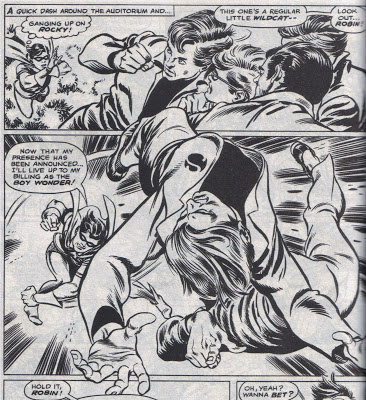
During this period, Robin had a backup series in Detective, usually alternating with Batgirl. In this particular story, young Dick Grayson and his intrepid colleagues at the Gotham High Owl uncover some corruption involving a new school annex and a teachers' strike. The bullies that Robin takes out are really mob enforcers disguised as a gang from a rival high school, but Robin sees through their disguise due to the gang's suspicious ability to grow facial hair.
This story is pretty punch-a-rific, so you'll probably see it come up again in a future entry.
Categories: Blogs of The Bureau Chiefs
Blackhawk Wingsdays: A Blackhawk Christmas Tale!
So, I was wracking my brain the other night, trying to remember if I'd ever seen a Blackhawk Christmas story that I could use in celebration of the coming holiday. Then it dawned on me that Mark Evanier had to have written one during his early 80s run on the series. That seems like just the thing that Evanier would do.
I wasn't disappointed. While looking through the Evanier/Dan Spiegle run, I found "A Blackhawk Christmas Tale," starring Olaf, in Blackhawk 268 (Mar. 1984).
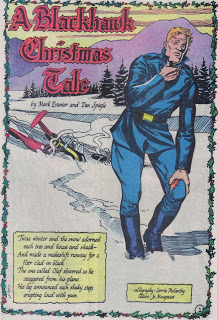
And what's even better, the story is written in rhymed verse.
Now, before I get started here, I just want to say that I think the Evanier/Spiegle issues of Blackhawk are just fantastic--probably the best thing that Evanier ever wrote, and I'm a fan of his DNAgents and Crossfire series as well. That being said, Evanier has a tendency to veer toward the sentimental, and while the sentimental can be forgiven in a Christmas story, it does lead to a problematic and overly simplified message at the end of this particular story.
Also, Evanier is not a great poet by any stretch of the imagination. He often uses a convoluted syntax to get his rhymes in the right place, and his lines don't always scan, as we can see in the first lines of the verse below:
(But I do have to applaud Evanier for rhyming "act of fate" with "a Nazi in a BF108" in an earlier stanza.)
Anyway, Olaf is shot down by a Nazi plane, and he crashlands in a snowy field, escaping the wreck with a wounded leg. The Nazi lands to ensure his kill was successful, so Olaf has to find a place to hide fast. He comes across a cabin inhabited by a Jewish family named "Meyer." The Meyers care for the wounded Swede, and Olaf then asks them how the family got to this place.
Instead of giving Olaf a simple answer, however, the father tells the entire history of the Jewish diaspora.
I don't think this really answers Olaf's question.
The Nazis, meanwhile, have trailed Olaf to the cabin, where they break in and attack the family.
Once again, though, I have to give Evanier some credit for these top-notch rhymes: wide/genocide, disabuse/Jews.
Olaf manages to escape out the back with the family, and just as they leave, a huge blizzard kicks up.
Miraculously, however, the storm parts, allowing Olaf and the family to gain freedom while the Nazis get frozen in their tracks.
Now, here's where I think Evanier's sentiment goes wrong. It's one thing to include a miracle in a Christmas story (and let's ignore for a minute that this is called "A Blackhawk Christmas Story" even though its primary subject is a Jewish family). But having God intervene to save one Jewish family during the Holocaust leads one to wonder why similar miracles weren't produced for, say, the other 6 million Jews that the Nazis did manage to kill. Not a real successful ratio.
As he heals from his leg wound, Olaf asks the Meyers to teach him about Chanukah . In turn, Olaf teaches them about Swedish Christmas traditions.
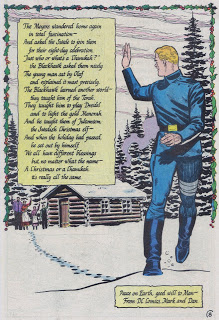
Interestingly, Olaf leaves out some of the Swedish holiday traditions that I'm familiar with from my time growing up in North Dakota: the desperate attempts to swallow the disgusting lutefisk quickly without tasting it or gagging, the emotional reservedness that would inevitably explode at the most inappropriate times during family gatherings, all of which have nothing to do with some weird Christmas elf.
And, again problematically, Evanier ends the poem with a bit of cultural equivocation that Chanukah and Christmas are basically the same thing. Even when I was a kid, I knew this wasn't true, as my Jewish friends all told me about the great gifts they got for eight nights in a row, while I had to wait (impatiently) for Christmas morning to see what Santa brought, which usually didn't total eight gifts. I know Evanier means well by sending a message of equality and love for all, and even setting aside my childhood greed and jealousy, this is a faulty sentiment that advocates ignoring the importance of cultural differences. Also, Christmas isn't even mentioned in this story until the very end.
I wasn't disappointed. While looking through the Evanier/Dan Spiegle run, I found "A Blackhawk Christmas Tale," starring Olaf, in Blackhawk 268 (Mar. 1984).

And what's even better, the story is written in rhymed verse.
Now, before I get started here, I just want to say that I think the Evanier/Spiegle issues of Blackhawk are just fantastic--probably the best thing that Evanier ever wrote, and I'm a fan of his DNAgents and Crossfire series as well. That being said, Evanier has a tendency to veer toward the sentimental, and while the sentimental can be forgiven in a Christmas story, it does lead to a problematic and overly simplified message at the end of this particular story.
Also, Evanier is not a great poet by any stretch of the imagination. He often uses a convoluted syntax to get his rhymes in the right place, and his lines don't always scan, as we can see in the first lines of the verse below:

(But I do have to applaud Evanier for rhyming "act of fate" with "a Nazi in a BF108" in an earlier stanza.)
Anyway, Olaf is shot down by a Nazi plane, and he crashlands in a snowy field, escaping the wreck with a wounded leg. The Nazi lands to ensure his kill was successful, so Olaf has to find a place to hide fast. He comes across a cabin inhabited by a Jewish family named "Meyer." The Meyers care for the wounded Swede, and Olaf then asks them how the family got to this place.
Instead of giving Olaf a simple answer, however, the father tells the entire history of the Jewish diaspora.

I don't think this really answers Olaf's question.
The Nazis, meanwhile, have trailed Olaf to the cabin, where they break in and attack the family.

Once again, though, I have to give Evanier some credit for these top-notch rhymes: wide/genocide, disabuse/Jews.
Olaf manages to escape out the back with the family, and just as they leave, a huge blizzard kicks up.
Miraculously, however, the storm parts, allowing Olaf and the family to gain freedom while the Nazis get frozen in their tracks.

Now, here's where I think Evanier's sentiment goes wrong. It's one thing to include a miracle in a Christmas story (and let's ignore for a minute that this is called "A Blackhawk Christmas Story" even though its primary subject is a Jewish family). But having God intervene to save one Jewish family during the Holocaust leads one to wonder why similar miracles weren't produced for, say, the other 6 million Jews that the Nazis did manage to kill. Not a real successful ratio.
As he heals from his leg wound, Olaf asks the Meyers to teach him about Chanukah . In turn, Olaf teaches them about Swedish Christmas traditions.

Interestingly, Olaf leaves out some of the Swedish holiday traditions that I'm familiar with from my time growing up in North Dakota: the desperate attempts to swallow the disgusting lutefisk quickly without tasting it or gagging, the emotional reservedness that would inevitably explode at the most inappropriate times during family gatherings, all of which have nothing to do with some weird Christmas elf.
And, again problematically, Evanier ends the poem with a bit of cultural equivocation that Chanukah and Christmas are basically the same thing. Even when I was a kid, I knew this wasn't true, as my Jewish friends all told me about the great gifts they got for eight nights in a row, while I had to wait (impatiently) for Christmas morning to see what Santa brought, which usually didn't total eight gifts. I know Evanier means well by sending a message of equality and love for all, and even setting aside my childhood greed and jealousy, this is a faulty sentiment that advocates ignoring the importance of cultural differences. Also, Christmas isn't even mentioned in this story until the very end.
Categories: Blogs of The Bureau Chiefs
